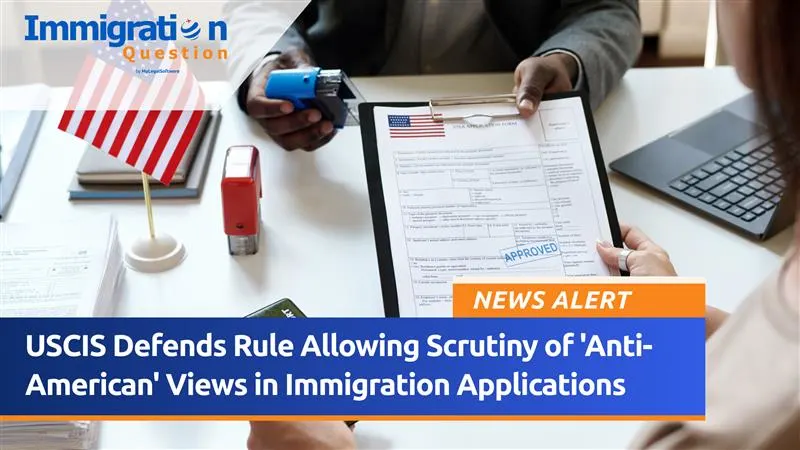
In a recent interview, the head of U.S. Citizenship and Immigration Services (USCIS) defended a new rule allowing immigration officers to scrutinize whether applicants for green cards, visas, or other benefits have expressed “anti-American” views. The policy has sparked sharp debate over free speech, national security, and the limits of immigration oversight.
Rule Targets Expressions Linked to Terrorism and Extremism
USCIS Director Joseph Edlow explained that the new policy, announced last month, authorizes officers to consider whether applicants have “endorsed, promoted, supported, or espoused” anti-American, terrorist, or antisemitic beliefs. He stressed the rule is not intended to punish political opposition or criticism of government but to address support for extremist organizations and ideologies that threaten U.S. security.
Edlow emphasized that criticism of any administration, including President Donald Trump’s, remains “one of the most American activities.” Instead, the agency is focused on identifying individuals who explicitly align themselves with terrorist causes or advocate violence against the United States.
Concerns Over Broad Discretion and Free Expression
The rule has raised concerns among immigrant advocates and legal experts. They argue it might allow officers too much leeway to deny applications based on personal views of speech. Questions have come up about whether online posts, protests, or controversial political statements could affect eligibility for legal status.
Edlow defended the approach by citing examples like students who openly support Hamas or join protests that prevent Jewish students from accessing facilities. The Trump administration has prioritized limiting student-led demonstrations, claiming some protests cross into antisemitism and incitement.
Verification of Public Benefits and Voter Rolls
Another area of expansion involves the Systemic Alien Verification for Entitlements (SAVE) program, which government agencies use to confirm eligibility for public benefits. Edlow said USCIS has streamlined access by allowing agencies to use Social Security numbers instead of specialized identifiers.
USCIS is also working with state election officials to verify voter rolls. Edlow argued that this measure aims to prevent voter fraud. However, critics warn that errors could lead to wrongful removals and privacy risks. He assured that a “huge team” verifies the accuracy of the data.
International Students and Work Authorization
Edlow discussed the contentious Optional Practical Training (OPT) program. This program lets international students work after graduation. About 240,000 people take part in it. There are extensions available for graduates in science, technology, engineering, and math.
While not calling for an immediate end, Edlow said he wants to place “parameters” on OPT to ensure it does not give employers incentives to hire foreign students over U.S. graduates for short-term or lower-cost positions.
Citizenship Test and H1-B Visa Concerns
The USCIS director also confirmed plans to revise the citizenship test, reverting to a more demanding version introduced in 2020 under Trump’s first term. He argued the current test is “too easy”. He may soon include written essays to better measure constitutional knowledge and English skills.
On employment visas, Edlow raised concerns over the H1-B program, widely used in the tech industry. He warned of the visa risks, citing the “displacement of American workers,” as companies may hire foreign professionals at lower wages, thereby undercutting U.S. employees.
Looking Ahead
The USCIS rule on “anti-American” views represents another significant change in how the Trump administration defines eligibility for immigration benefits. Supporters view it as a protection against extremism. At the same time, critics caution that it could harm free speech and give more power to adjudicators.
As the agency expands its enforcement role and examines programs such as OPT, citizenship testing, and H-1 B visas, the discussion emphasizes how immigration policy is being redefined beyond just border security. The results will have long-term implications for applicants, employers, and the broader U.S. immigration system.
For timely updates and analysis on immigration enforcement and related immigration issues, visit ImmigrationQuestion.com. Get answers to your immigration questions from licensed immigration attorneys. For attorneys, use our innovative 2-in-1 case management software to grow your practice. Download our free app on Google Play and the Apple App Store.
Resources:
**ImmigrationQuestion.com is a third-party platform that serves as a meeting ground for licensed immigration attorneys and people with immigration questions. It is not a law firm. It is not affiliated with or endorsed by USCIS or AILA. Attorneys on this platform are independent and have the discretion to offer a free consultation and/or set their fees under the law.