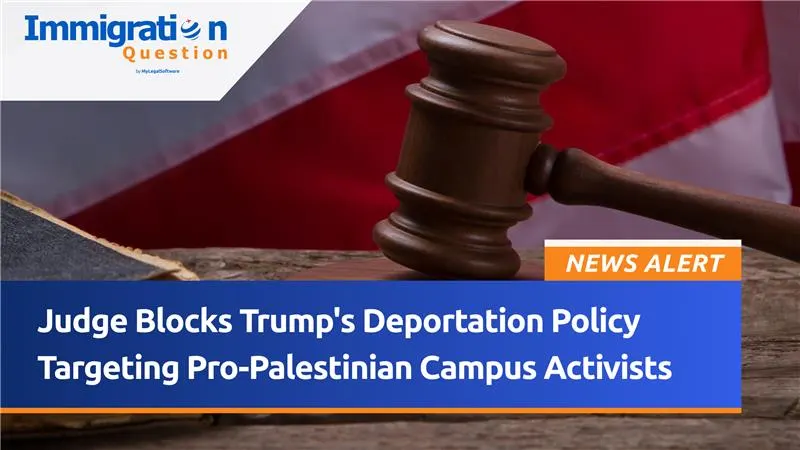
A federal judge in Boston has ruled that the Trump administration acted unconstitutionally in targeting pro-Palestinian campus activists for deportation. The decision halts visa revocations, arrests, and removals carried out against international students and faculty, as the court found that the policy violated First Amendment protections of free speech and academic advocacy.
Court Ruling Strikes Down Deportation Policy
U.S. District Judge William Young issued a sweeping decision on Tuesday, declaring that the Trump administration’s actions to deport international students and faculty over pro-Palestinian advocacy violated the Constitution. The ruling blocks a policy that sought to revoke visas, detain, and remove noncitizens engaged in campus activism.
Judge Young stated that the Departments of State and Homeland Security acted “in concert” to misuse their powers, targeting individuals primarily for exercising protected political speech. His 161-page opinion described the administration’s efforts as an unlawful attempt to silence dissent on U.S. college campuses.
The judge emphasized that freedom of expression is a constitutional principle that applies broadly, including to noncitizens living in the United States on student and faculty visas.
Case Emerges from Campus Crackdown
The decision followed months of legal challenges from faculty groups, including the American Association of University Professors and the Middle East Studies Association. They argued that students and scholars were being targeted for their political views, rather than for real security issues.
Judge Young pointed to the arrest of Rumeysa Ozturk, a Tufts University student who was taken into custody after writing an opinion piece critical of Israel’s war in Gaza. This case illustrates retaliation against speech that the Constitution protects. He denounced the use of masked ICE agents in the arrest, saying their appearance evoked secret police tactics that had no place in American society.
Plaintiffs in the lawsuit argued that the administration’s actions sought to create a “climate of fear” among international students and academics, deterring them from engaging in lawful political expression.
Broader Context of Trump’s Orders
President Trump had signed executive orders earlier this year directing federal agencies to confront anti-Semitism and strengthen immigration enforcement.
The administration subsequently revoked visas and ordered arrests of hundreds of students and faculty with pro-Palestinian affiliations. Among the first was Columbia University graduate Mahmoud Khalil, whose detention in March sparked the lawsuit.
Human rights organizations and academic groups argue that the crackdown is part of a broader pattern in which immigration powers are being used to limit dissent and silence opposition voices. The Boston ruling is the strongest judicial rebuke of that approach to date.
White House Vows to Appeal
In response to the ruling, White House spokesperson Liz Huston called the decision “outrageous” and said the administration would pursue an appeal. She argued that studying in the United States is a privilege, not a right, and that the government must safeguard national security and campus safety.
Justice Department lawyers told the 2nd U.S. Circuit Court of Appeals they may seek to re-detain students like Ozturk if higher courts overturn Judge Young’s ruling. Legal observers note the case could reach the Supreme Court if the administration moves forward with its appeal strategy.
A Look Ahead
The ruling is viewed as a significant affirmation of First Amendment protections for noncitizens in academia. Advocacy groups celebrated it as a significant victory for free speech. However, the administration’s decision to appeal signals a potentially lengthy legal battle ahead.
Observers caution that the outcome could significantly influence the balance between immigration enforcement and constitutional rights on college campuses for years to come. ImmigrationQuestion.com will continue to track the case as the courts consider the future of academic freedom and immigration enforcement under President Trump.
For more immigration news and expert analysis, visit www.ImmigrationQuestion.com. Get answers to your immigration questions from licensed immigration attorneys. For attorneys, use our innovative 2-in-1 case management software to grow your practice. Download our free app on Google Play and the Apple App Store.
Resources:
**ImmigrationQuestion.com is a third-party platform that serves as a meeting ground for licensed immigration attorneys and people with immigration questions. It is not a law firm. It is not affiliated with or endorsed by USCIS or AILA. Attorneys on this platform are independent and have the discretion to offer a free consultation and/or set their fees under the law.