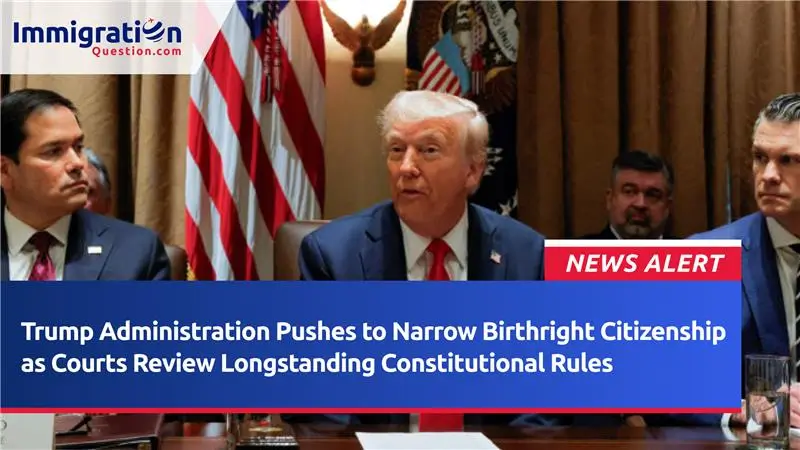
The Trump administration has asked the Supreme Court to review its directive limiting birthright citizenship. They argue that U.S. policy should reflect current international standards. This move challenges a broad interpretation of the Fourteenth Amendment and has led to ongoing legal battles as courts consider whether automatic citizenship can be restricted based on parents’ status.
Justice Department Urges Supreme Court Review
The Justice Department has filed a petition urging the Supreme Court to review President Trump’s executive order that restricts automatic citizenship for children born in the United States. Officials assert that limiting birthright citizenship would bring the U.S. closer to global norms, where many nations grant citizenship based primarily on parental status rather than birthplace.
The administration’s filing emphasizes that the longstanding American approach has positioned the country as an outlier among developed nations. Government lawyers argue that rethinking the interpretation of the Fourteenth Amendment is necessary to maintain the integrity and value of U.S. citizenship globally.
Legal Challenges Surround Executive Order
The directive prevents children born in the U.S. from automatically receiving citizenship based on their parents’ immigration or legal status. Legal challenges have continued since the order was issued in January. Recently, courts found the policy likely inconsistent with established law. The Justice Department is seeking a clear ruling to define the limits of presidential authority.
Prior rulings have been mixed. A procedural victory was granted in June, but later decisions have repeatedly suggested that the executive order may be unlawful. The Supreme Court is now poised to consider both the constitutional arguments and the broader policy implications of limiting birthright citizenship.
International Models Highlight Competing Approaches
This is a model followed by most countries, including Germany and Japan, as well as several states in Northern Europe, in which jus sanguinis predominates over the U.S. model of jus soli, established under the Fourteenth Amendment, which grants citizenship to nearly all individuals born on U.S. soil.
The difference between these models reflects broader variations in legal tradition and national policy. While jus soli is common in the Americas, jus sanguinis is still widespread in much of Europe and Asia. The administration believes that aligning U.S. policy with these global practices would reflect changing international norms.
Historical Context and Global Trends
Birthright citizenship began in 17th-century England, where being born under the monarch’s authority made one a subject. This principle helped expand British influence by guaranteeing citizenship rights to children born in the colonies. Over time, this rule changed in countries due to shifts in migration and demographic patterns.
For example, the United Kingdom changed its law in 1983 to combine jus soli and jus sanguinis. Today, whether a child acquires citizenship depends on the citizenship or legal residency of the parents. Proponents of the executive order cite such changes internationally to argue that limiting automatic U.S. citizenship would not be out of step. Critics, however, say the historical context complicates such a comparison.
A Look Ahead
The Supreme Court is likely to consider the Justice Department’s request over the next few days. Onlookers say the case would open a broad debate about how to interpret the Fourteenth Amendment, the role of the judiciary when presidential power is at stake, and whether U.S. policies on citizenship align with international standards.
For continuous updates on federal immigration policies, citizenship rules, and related court decisions, visit ImmigrationQuestion.com, a meeting ground for individuals seeking clarity on U.S. immigration policy.
Get answers to your immigration questions from licensed immigration attorneys. For attorneys, use our innovative 3-in-1 case management software to improve your practice. Download our free app on Google Play Store and the Apple App Store.
Resources:
**ImmigrationQuestion.com is a networking platform founded by Immigration Attorneys. It serves as a meeting ground for licensed immigration attorneys and people with immigration questions. It is not a law firm. It is not affiliated with or endorsed by USCIS or AILA. Attorneys on this platform are independent and have the discretion to offer a free consultation and/or set their fees under the law.