
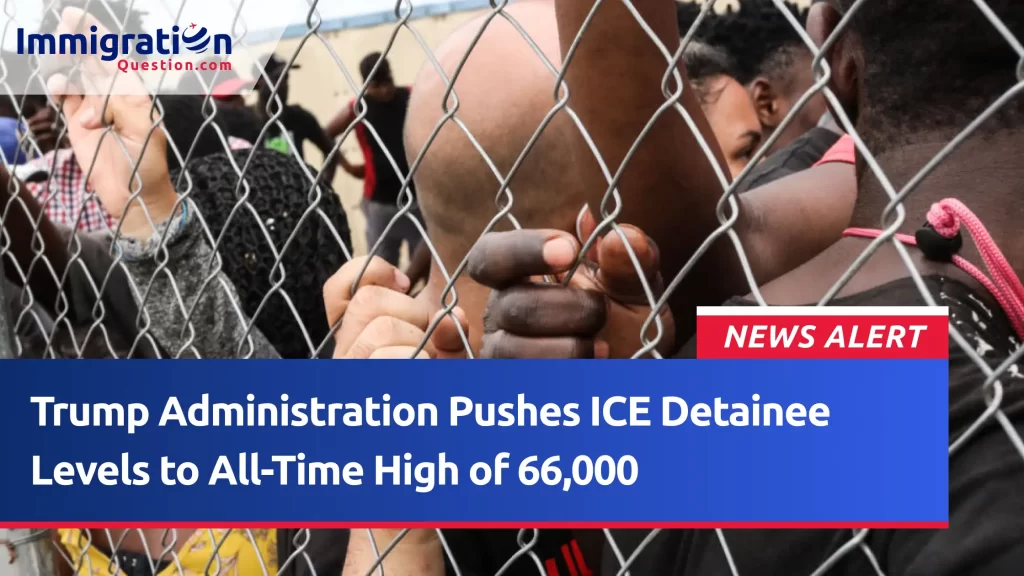
The number of detainees in U.S. Immigration and Customs Enforcement custody has reached 66,000, the highest in the agency’s history. The record-breaking increase follows the Trump administration’s expanded enforcement powers, broadened arrest mandates, and the establishment of a growing network of new detention centers across the nation. Officials expect the numbers to keep rising.
Record Numbers Reflect Expanding Detention Powers
The U.S. Immigration and Customs Enforcement (ICE) now holds 66,000 detainees, an unprecedented figure that highlights the Trump administration’s intensified enforcement approach. Internal Department of Homeland Security data shows ICE’s detainee population has surged nearly 70 percent since January, when the agency held about 39,000 people.
The previous record, roughly 56,000 detainees, was set during Trump’s first term in 2019. With new and converted detention facilities now in operation, ICE’s capacity has reached levels unseen in modern immigration enforcement. Analysts say the record figure underscores a deliberate strategy to expand the agency’s power to detain immigrants regardless of criminal record.
Expansion of Detention Capacity
To manage the rising number of detainees, ICE has increased its available bed space to nearly 70,000, up from 41,500 earlier this year. The expansion includes converted military bases and privately run facilities, primarily in Republican-led states. Funding came from $45 billion set aside under the One Big Beautiful Bill Act.
Officials are planning further expansion for 2026, which could raise national detention capacity to 100,000 beds. While DHS claims the aim is to prevent overcrowding, advocates and independent monitors caution that conditions in many ICE facilities are still unsafe and poorly regulated, even with increased oversight.
Rising Noncriminal Detentions
Internal DHS data shows that half of all ICE detainees, around 33,000 people, have no criminal charges or convictions. These individuals are detained solely for civil immigration violations, such as overstaying their visas or entering the country without authorization. ICE categorizes them as “immigration violators.”
Analysts say the administration’s expanded arrest mandate has significantly widened its enforcement net, often resulting in “collateral arrests” of individuals who were not initially targeted. The result, professionals note, is a detention system increasingly driven by volume rather than criminal risk, with fewer releases and bond approvals compared to prior years.
Arrest and Deportation Targets
Since Trump’s second inauguration, ICE has carried out an estimated number of 278,000 arrests, averaging nearly 1,000 daily. Combined with Customs and Border Protection operations, total enforcement arrests exceed half a million. Deportations stand at roughly 380,000, while DHS data show more than 570,000 removals, including self-departures and repatriations.
Internal DHS briefings outline a broader enforcement goal of 3,000 arrests per day and up to one million deportations annually. Officials argue these targets are essential to restoring immigration order. Policy analysts, however, warn that such high-volume enforcement risks overwhelming detention facilities and due process protections.
Conditions and Oversight Challenges
The increasing number of detainees has raised concerns about facility conditions. A federal judge in Chicago recently ordered ICE to improve standards at the Broadview, Illinois, processing center after reports of overcrowding, limited access to hygiene products, and inadequate food supplies.
ICE denies claims of neglect, stating that it continues to expand detention space and avoid overcrowding responsibly. Advocacy groups, however, argue that mass detention systems inherently limit oversight and accountability, leading to ongoing worries about detainee welfare as enforcement grows.
Looking Ahead
The record-high detention numbers are expected to continue increasing through 2026 as the administration expands enforcement operations nationwide. New contracts and facilities are already in development, indicating a long-term shift toward prolonged detention as a key immigration strategy.
For continued coverage of U.S. detention policy, immigration enforcement, and DHS operations, visit ImmigrationQuestion.com. Get answers to your immigration questions from licensed immigration attorneys. For attorneys, use our innovative 3-in-1 case management software to improve your practice. Download our free app on Google Play and the Apple App Store.
Resources:
**ImmigrationQuestion.com is a networking platform that serves as a meeting ground for licensed immigration attorneys and people with immigration questions. It is not a law firm. It is not affiliated with or endorsed by USCIS or AILA. Attorneys on this platform are independent and have the discretion to offer a free consultation and/or set their fees under the law.