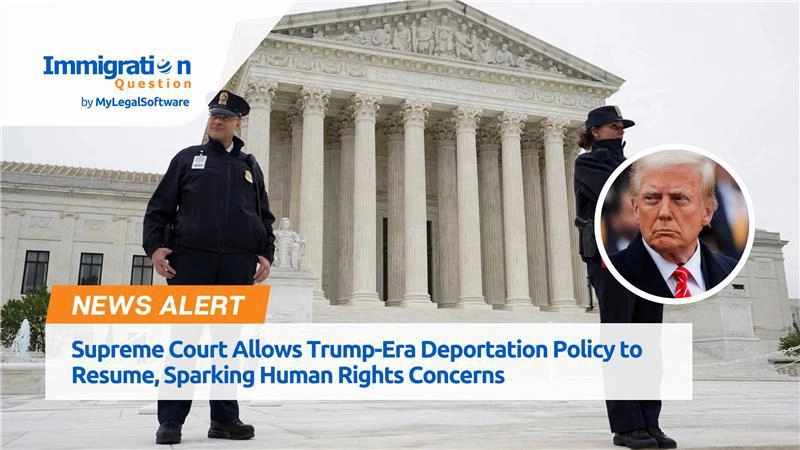
In a closely divided decision, the U.S. Supreme Court on Monday allowed the Trump administration to resume fast-track deportations of migrants to third countries—even when those destinations are not their home nations—reviving a controversial immigration policy that critics say puts lives at risk and erodes legal protections.
The ruling lifts a lower court’s order that had temporarily blocked the practice, which had allowed migrants to challenge such deportations in court. The high court’s majority offered no detailed reasoning for the decision. However, Justice Sonia Sotomayor, joined by Justices Elena Kagan and Ketanji Brown Jackson, issued a sharply worded dissent warning of the potential human cost.
Controversial Policy Moves Forward Despite Legal Objections
In response to the court’s green light, Department of Homeland Security spokesperson Tricia McLaughlin indicated that deportations to third countries could resume imminently. However, a judge in Boston, U.S. District Judge Brian E. Murphy, maintained that a previous order allowing migrants to raise concerns about the dangers of deportation to certain countries remains in effect. In one instance, migrants from Myanmar, Vietnam, and Cuba were scheduled for removal to South Sudan. They were rerouted to a U.S. naval base in Djibouti after legal challenges delayed their flight.
According to their attorney, Trina Realmuto of the National Immigration Litigation Alliance, these individuals face possible imprisonment, torture, and even death if ultimately deported to South Sudan—one of the world’s most unstable and violent nations.
Legal Uncertainty and Humanitarian Fallout Continue
The decision adds fresh uncertainty to the already chaotic immigration enforcement landscape of Trump’s second term, which has been marked by aggressive deportation pushes and hardline rhetoric. Although the administration maintains constitutional and federal statutory grounds to expedite removals, immigration attorneys warn that many deportees have been given limited or no time to appeal their removals or pursue asylum claims.
According to Sotomayor, these deportations are happening in as little as 16 hours, citing a recent example involving a gay Guatemalan man wrongly deported to Mexico—where he says he was raped and extorted. After a legal fight, he became the first known person to return to the U.S. after being deported by the Trump administration.
Judge Murphy, appointed by President Biden, previously ruled that while deportations to third countries aren’t banned outright, migrants must be allowed to present credible fears of torture or persecution before being removed. Migrants housed in Djibouti after the May deportation attempt reportedly endured difficult conditions in a converted shipping container alongside ICE officers.
International Agreements Add to Legal Complexity
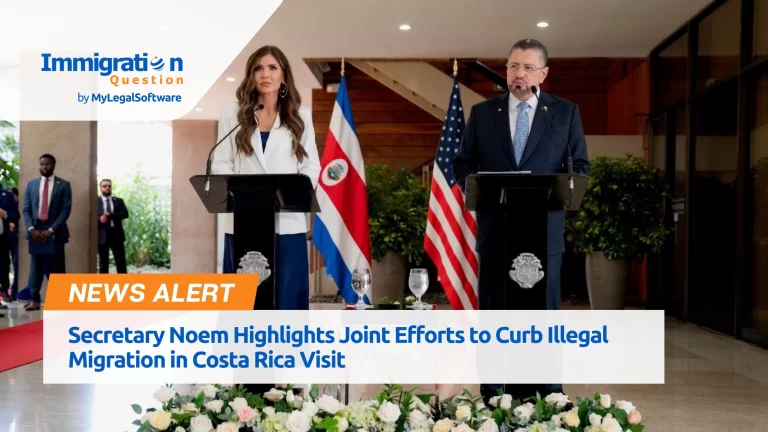
The government has planned with several countries, including Costa Rica and Panama, to host migrants removed from the U.S. because their home countries won’t accept them. Lawyers say the plan raises serious issues under both U.S. and international law.
However, any removal orders can be appealed to the Board of Immigration Appeals and possibly taken to federal court, which can delay deportations but not guarantee long-term safety.
What’s Next? Broader Implications for Immigration Law and Due Process
As the administration scrambles to reassert control over immigration enforcement, advocates warn that the consequences could be disastrous—not just for the migrants themselves who are at risk, but for the overall rule of law.
Chris Newman, who represents families affected by the policy, emphasized that this isn’t just about immigration; it’s about whether constitutional protections apply to everyone—or only to a chosen few.
For timely updates and analysis on immigration enforcement and related immigration issues, visit ImmigrationQuestion.com. Get answers to your immigration questions from licensed immigration attorneys. For attorneys, use our mind-blowing 2-in-1 case management software to grow your practice. Download our free app on Google play and App Store.
Resources
- https://apnews.com/article/supreme-court-immigration-trump-south-sudan-c7ffbbcede3158a3352b2dbf4439780a
- https://economictimes.indiatimes.com/news/international/global-trends/supreme-court-allows-trump-to-restart-swift-deportation-of-migrants-away-from-their-home-countries/articleshow/122036269.cms?from=mdr
- https://www.pbs.org/newshour/politics/supreme-court-allows-trump-to-restart-swift-deportation-of-migrants-to-locations-that-are-not-their-home-countries
- https://blog.immigrationquestion.com/news/u-s-expands-deportation-efforts-to-include-nations-like-equatorial-guinea/
**Immigration Question is a third-party platform that connects licensed immigration attorneys with users, it is not a law firm. It is not affiliated with or endorsed by USCIS or AILA. Attorneys on this platform are independent and have the discretion to offer a free consultation and/or set their own fees under the law.