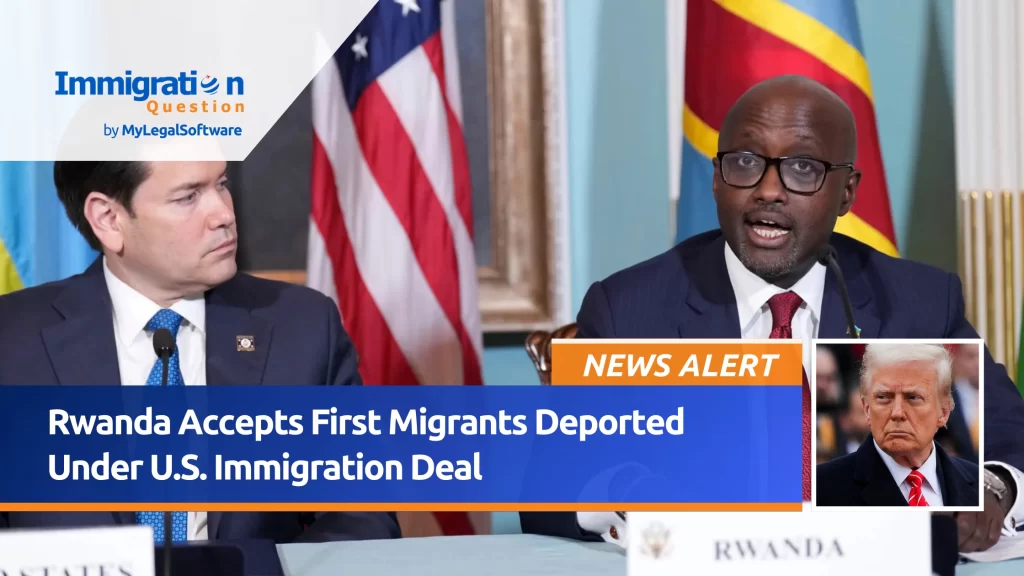
Rwanda has received seven migrants deported from the United States, marking the first arrivals under a new bilateral agreement that allows Washington to transfer up to 250 individuals. The development underscores President Donald Trump’s expansion of third-country deportations, a policy drawing scrutiny for its implications on security, legality, and human rights.
First Transfers Under New Agreement
The Rwandan government confirmed Thursday that it had received the first group of migrants deported from the United States under a recently signed bilateral deal.
Government spokesperson Yolande Makolo stated that the seven individuals arrived in Kigali in mid-August after undergoing a vetting process conducted jointly by both governments.
Of the seven deportees, three expressed an interest in returning to their countries of origin, while four indicated they intend to remain in Rwanda and attempt to build new lives there.
Officials emphasized that regardless of their long-term decisions, the government is committed to providing support, including accommodation, healthcare, and social services.
Washington Expands Third-Country Deportations
The transfer follows an agreement reached earlier this month between Kigali and Washington, permitting Rwanda to receive up to 250 migrants. U.S. officials initially submitted a list of ten individuals, from which seven were approved for relocation.
The deal signals a growing reliance on third-country deportations as a central feature of U.S. immigration enforcement.
President Donald Trump has made immigration control a key issue of his administration. His team claims that deportations to third countries offer a way to quickly remove migrants who cannot stay in the United States.
This includes individuals with criminal records or cases where diplomatic or security issues complicate direct repatriation.
Limited Transparency from U.S. Officials
When questioned about the mid-August deportations, the U.S. State Department deferred to the Rwandan government for details. A spokesperson reiterated that implementing the Trump administration’s immigration priorities is an ongoing focus, stressing the importance of reducing illegal migration and bolstering national security.
The Department of Homeland Security, which is responsible for overseeing removals, did not provide an immediate response. Washington’s limited disclosure on specific transfers has fueled criticism that affected migrants and receiving countries are left to manage the humanitarian and logistical dimensions without sufficient transparency from U.S. agencies.
Rwanda as a Relocation Partner
Over the past decade, Rwanda has increasingly positioned itself as a destination for migrants being resettled under agreements with Western nations.
Supporters of such deals argue that Rwanda provides organized assistance to deportees. However, critics highlight Rwanda’s human rights record and limits on political freedoms. International rights groups warn that moving vulnerable people to Rwanda may leave them with inadequate protections and few long-term chances to integrate.
Humanitarian and Political Debate
Supporters of third-country deportations argue that this policy eases overcrowding in U.S. detention centers. It also addresses individuals who are challenging to deport directly due to their nationality or concerns about their safety.
Opponents argue that transferring people to a third country is inhumane. It places migrants in unfamiliar settings where they might lack family, community ties, or cultural connections. Humanitarian groups warn that deportees face risks of isolation, instability, or even violence in host countries. This makes the practice seem politically convenient but ethically questionable.
Looking Ahead
Under the U.S.-Rwanda agreement, deportees are expected to receive job training, housing, and healthcare to assist their resettlement. As future transfers are considered, debate is likely to intensify over whether the U.S.-Rwanda partnership can serve as a sustainable model for handling migration or whether it represents a troubling outsourcing of humanitarian responsibility.
For timely updates and analysis on immigration enforcement and related immigration issues, visit ImmigrationQuestion.com. Get answers to your immigration questions from licensed immigration attorneys. For attorneys, use our innovative 2-in-1 case management software to grow your practice. Download our free app on Google Play and the Apple App Store.
Resources:
- https://www.reuters.com/world/africa/rwanda-received-migrants-deported-us-earlier-this-month-2025-08-28/
- https://www.aljazeera.com/news/2025/8/28/rwanda-confirms-it-received-seven-immigrants-deported-under-donald-trump
- https://www.bbc.com/news/articles/ckg4xp2my0vo
- https://businessday.ng/africa/article/rwanda-confirms-arrival-of-first-set-of-migrants-deported-from-us/
**ImmigrationQuestion.com is a third-party platform that serves as a meeting ground for licensed immigration attorneys and people with immigration questions. It is not a law firm. It is not affiliated with or endorsed by USCIS or AILA. Attorneys on this platform are independent and have the discretion to offer a free consultation and/or set their fees under the law.