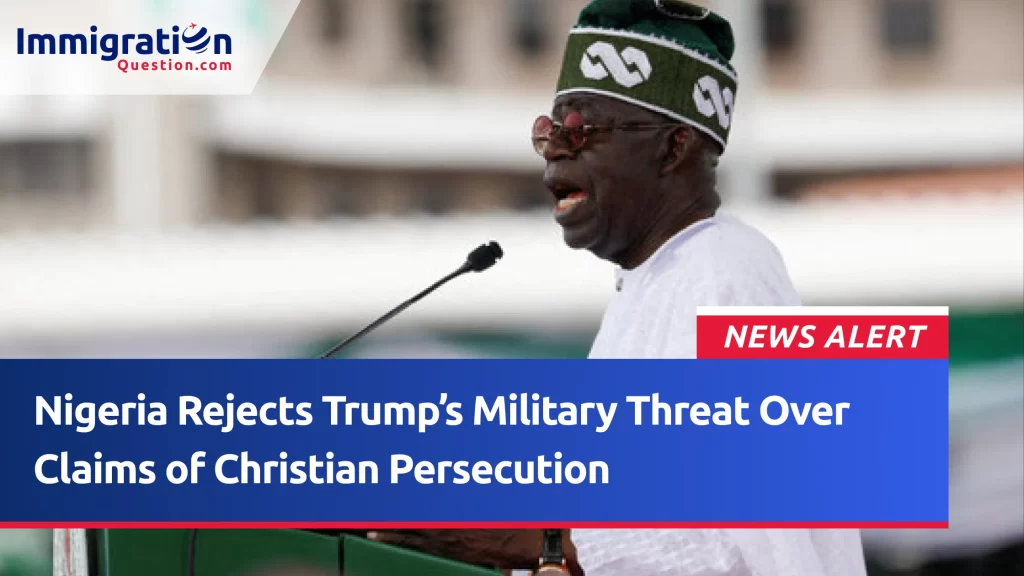
Nigeria has firmly rejected U.S. President Donald Trump’s threat to take military action over the supposed persecution of Christians. They described the claim as incorrect and a breach of their sovereignty. Officials maintain that violence in Nigeria affects both Christians and Muslims and warn that foreign interference could inflame an already complex security situation.
Nigeria Rejects U.S. Military Threat Over Religious Allegations
The Nigerian government has rejected President Donald Trump’s threat to authorize U.S. military action in Nigeria, describing the move as unfounded and deeply disrespectful to the country’s sovereignty. Presidential spokesman Daniel Bwala said any unilateral operation by the U.S. would violate international law and misrepresent the realities of Nigeria’s internal conflict.
Trump announced over the weekend that he had instructed the Pentagon to prepare potential military plans, claiming that Christians were being targeted in Nigeria. He also warned that the U.S. would halt all aid to the country and “go in guns blazing” if the Nigerian government failed to stop the alleged persecution.
Nigeria Denies Religious Persecution Claims
Bwala argued that Trump’s comments misrepresented Nigeria’s domestic challenges and appeared to be an attempt to pressure the government into political dialogue. He said both Christians and Muslims have suffered from extremist attacks and armed banditry, rejecting any suggestion that the government condones religiously motivated violence.
President Bola Ahmed Tinubu also dismissed the U.S. designation of Nigeria as a country of particular concern for religious freedom violations. He reaffirmed Nigeria’s commitment to protecting communities of all faiths and working with international partners through diplomatic and security frameworks.
Violence Driven by Complex Conflicts
Security analysts and international observers say that Nigeria’s ongoing violence, which includes the Boko Haram insurgency, herder-farmer conflicts, and armed gang activity, cannot be understood through a religious lens alone. Reports from the Associated Press and other sources show that attacks often arise from territorial disputes, banditry, and weak governance instead of religious persecution. The Nigerian government continues to carry out air operations and ground offensives in troubled regions.
Analysts Cite Broader State Failures
Critics warn that the U.S. response shows frustration with Nigeria’s approach to handling insecurity. Analysts from SBM Intelligence say years of limited government accountability have allowed attacks to persist, reinforcing perceptions of state failure. Researchers from the Institute of Security Studies note that unless Nigeria demonstrates tangible progress against insurgents and armed groups, external criticism will persist.
Analysts observed that the violence persists because local grievances remain unresolved, and the U.S. and others are responding to what they see as chronic inaction.
Diplomatic Tensions Mount
Nigeria’s foreign ministry has called for restraint and dialogue amid growing international attention. While the Pentagon has not confirmed any planning activity, analysts warn that even the suggestion of U.S. military intervention could strain bilateral relations and destabilize regional cooperation.
The government of President Bola Ahmed Tinubu, however, emphasized that such security collaboration must occur through existing agreements, rather than unilateral threats. Nigerian officials say the primary task remains addressing internal instability through coordinated national and regional strategies, rather than relying on external enforcement.
Looking Ahead
Observers would expect both countries to open new diplomatic channels in the coming weeks aimed at dissipating tensions and explaining the way forward with cooperation. The episode highlights the delicate balance between national sovereignty and international pressure when addressing religious and security concerns in West Africa.
For continued coverage on U.S.–Africa relations, and immigration policy developments, visit ImmigrationQuestion.com. Get answers to your immigration questions from licensed immigration attorneys. For attorneys, use our innovative 3-in-1 case management software to grow your practice. Download our free app on Google Play and the Apple App Store.
Resources:
- https://apnews.com/article/nigeria-trumo-christians-persecution-2aa6ffc42eeedc260122021bf51b0028
- https://www.reuters.com/world/africa/trump-threatens-us-military-action-nigeria-over-treatment-christians-2025-11-01/
- https://www.bbc.com/news/articles/cev18jy21w7o
- https://www.washingtonpost.com/world/2025/11/02/nigeria-trump-military-threat-aid-cuts/
**ImmigrationQuestion.com is a third-party platform that serves as a meeting ground for licensed immigration attorneys and people with immigration questions. It is not a law firm. It is not affiliated with or endorsed by USCIS or AILA. Attorneys on this platform are independent and have the discretion to offer a free consultation and/or set their fees under the law.