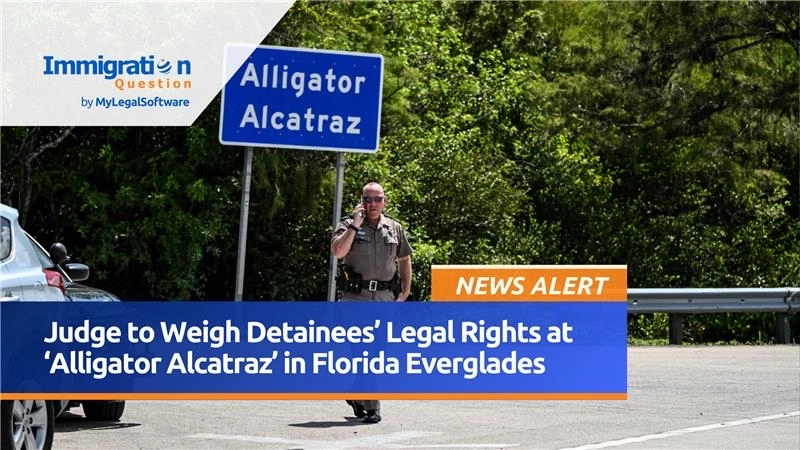
A federal judge in Miami is set to consider whether immigrant detainees at a temporary detention center in the Florida Everglades have been denied confidential legal access. Attorneys are seeking an injunction to ensure rights protection. At the same time, questions over court jurisdiction and ongoing environmental concerns complicate the future of the facility.
Hearing on Legal Access
On Monday, U.S. District Judge Rodolfo Ruiz will hear arguments in a lawsuit challenging the conditions at the detention facility nicknamed “Alligator Alcatraz.” Civil rights attorneys argue that detainees have been unable to consult privately with their lawyers, a right guaranteed in other immigration facilities nationwide.
The state of Florida disputes the claims, stating that detainees have had access to counsel since mid-July through videoconferencing, and with in-person visits permitted since late July. Attorneys counter that even when meetings occur, they are neither confidential nor timely, and the restrictions impair detainees’ ability to pursue their cases.
Jurisdiction Dispute
Before addressing detainees’ rights, Judge Ruiz indicated he will examine whether the case belongs in the U.S. District Court for the Southern District of Florida. The facility sits on land owned by Miami-Dade County. Still, it physically lies within Collier County, which falls under the Middle District of Florida.
State and federal lawyers maintain Miami is the wrong venue. Ruiz has suggested specific issues may fall under different districts and has asked attorneys to prepare to resolve the jurisdictional question before any ruling on preliminary relief.
Conditions Inside the Facility
The detention center opened in July on a remote Everglades airstrip. Attorneys claim that detainees describe coercion, including instances of pressure to sign voluntary removal orders without attorney consultation. Detainees have also reportedly been deported without final removal orders, presenting issues of due process.
Filings additionally allege that there are unsanitary conditions, including rainwater flooding in the tents in which the detainees reside, and respiratory infections. Advocates assert that the remote location of the facility makes it especially difficult to access legal aid or oversight.
Allegations of Coercion
Court documents document instances in which detainees were coerced into signing papers. One such case is of an intellectually disabled man who allegedly signed a form that he thought would allow him to receive a blanket, but was later deported through voluntary removal without counsel.
Attorneys representing legal visitors argue that these practices, along with delays and formal scheduling rules for legal visitation, create institutionalized obstacles that weaken constitutional rights. Florida officials deny the allegations and maintain all requests for legal access have been met.
Environmental Review and Construction Halt
The legal dispute over detainees’ rights comes alongside a separate lawsuit over the facility’s construction. U.S. District Judge Kathleen Williams recently ordered a temporary halt to additional building, citing possible violations of federal environmental rules. Judge Williams expects to issue a decision before the suspension expires this week.
Opponents argue that the detention center’s Everglades location not only threatens the environment but also compounds difficulties for detainees’ legal representation. The overlapping court challenges highlight the growing scrutiny facing Florida’s role in federal immigration enforcement.
What’s Next?
Even as litigation proceeds, Governor Ron DeSantis has announced plans for a second detention center in northern Florida, described as “Deportation Depot.” He said the expansion would provide the Trump administration with greater capacity to hold and deport immigrants.
Civil rights groups warn that additional facilities could replicate the same rights concerns raised at “Alligator Alcatraz.” The outcome of Monday’s hearing will determine whether detainees at the Everglades site gain expanded legal protections or remain subject to disputed practices.
For ongoing updates on federal court rulings, immigration enforcement, and humanitarian parole policy, visit ImmigrationQuestion.com, your trusted source for thorough U.S. immigration coverage.
For timely updates and analysis on immigration enforcement and related immigration issues, visit ImmigrationQuestion.com. Get answers to your immigration questions from licensed immigration attorneys. For attorneys, use our innovative 2-in-1 case management software to grow your practice. Download our free app on Google Play and the Apple App Store.
Resources:
**ImmigrationQuestion.com is a third-party platform that serves as a meeting ground for licensed immigration attorneys and people with immigration questions. It is not a law firm. It is not affiliated with or endorsed by USCIS or AILA. Attorneys on this platform are independent and have the discretion to offer a free consultation and/or set their fees under the law.