
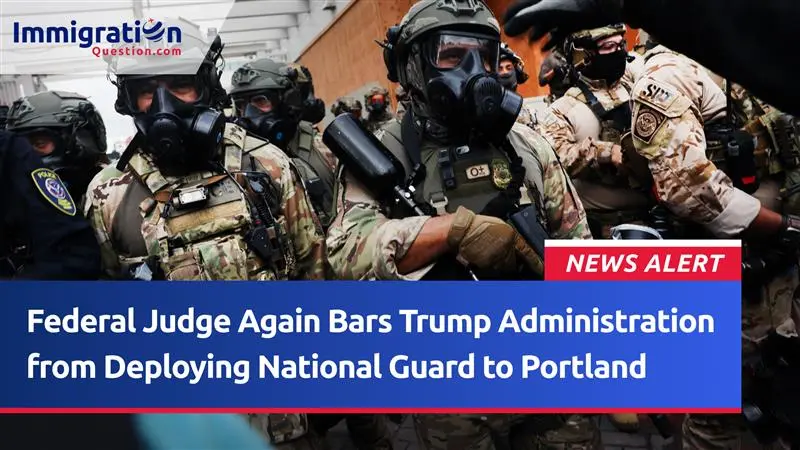
A federal judge in Oregon has once again barred the Trump administration from deploying National Guard troops to Portland, finding no credible evidence that protests in the city escalated beyond control. The decision delivers another legal setback to the administration’s efforts to use federal troops in domestic unrest cases.
Federal Judge Again Bars Trump Administration from Deploying National Guard to Portland
A federal judge in Oregon has extended an injunction blocking the Trump administration from sending National Guard troops to Portland, ruling that the evidence does not justify federal military intervention. The decision underscores ongoing legal resistance to the administration’s efforts to deploy forces to cities experiencing protests.
U.S. District Judge Karin Immergut, appointed by President Trump, issued her order on Sunday after a three-day hearing that examined the legality of the administration’s federalization of the Guard. She found that demonstrations near the U.S. Immigration and Customs Enforcement (ICE) facility in Portland were largely contained and did not rise to the level of rebellion or disorder required under federal law.
Court Challenges Federal Justification
The case, brought by the City of Portland and the State of Oregon, contests the administration’s claim that it can deploy the National Guard without state approval. Judge Immergut previously ruled that Trump’s depiction of Portland as war-ravaged and burning was untethered to the facts. Her latest ruling reaffirms that assessment.
The administration appealed to the 9th U.S. Circuit Court of Appeals, seeking to overturn the injunction. The appellate court had briefly lifted Immergut’s earlier order before reinstating it pending further review. For now, the troops remain federalized but are prohibited from deployment in Oregon.
Administration Cites Security Concerns
The Trump administration has argued that deploying federal troops is necessary to protect federal employees and property, particularly around the ICE building that was the focus of nightly protests earlier in the year. Officials from the Federal Protective Service testified about personnel shortages but acknowledged that they never formally requested National Guard assistance.
Legal analysts say the administration’s reliance on the Insurrection Act is misplaced. The act allows troop deployment only under extreme conditions, such as rebellion or obstruction of federal law—criteria that the court found to be unsupported by the available evidence in Portland’s case.
Local Officials Maintain Control
City and state officials have maintained that Portland’s police and local agencies are capable of managing demonstrations without the need for military involvement. Police representatives testified that, after revising their crowd control strategies in mid-June, the size and intensity of the protests significantly decreased.
Oregon’s Senior Assistant Attorney General Scott Kennedy argued that isolated incidents of vandalism or unrest do not meet the threshold for federal intervention. He added that city agencies have continued to function normally, even when temporary property damage occurred at the ICE facility.
Broader Implications for Federal Power
The ruling highlights an escalating national debate over presidential authority to deploy troops within U.S. borders. Several Democratic-led cities, including Chicago, have filed similar lawsuits challenging the administration’s federalization efforts, arguing that such actions violate state sovereignty and erode constitutional limits on executive power.
Judge Immergut stated she will issue a final ruling by Friday after reviewing over 750 pieces of evidence presented during the trial. Until then, her injunction prevents any National Guard presence on Portland’s streets under federal command.
Looking Ahead
Legal analysts predict a prolonged appeal process that could define how future administrations interpret the limits of federal power during periods of civil unrest. The outcome may also influence how states negotiate control over their National Guard units in politically charged emergencies.
For continued coverage of federal court rulings, protest-related policies, and U.S. immigration developments, visit ImmigrationQuestion.com. Get answers to your immigration questions from licensed immigration attorneys. For attorneys, use our innovative 3-in-1 case management software to grow your practice. Download our free app on Google Play and the Apple App Store.
Resources:
**ImmigrationQuestion.com is a third-party platform that serves as a meeting ground for licensed immigration attorneys and people with immigration questions. It is not a law firm. It is not affiliated with or endorsed by USCIS or AILA. Attorneys on this platform are independent and have the discretion to offer a free consultation and/or set their fees under the law.