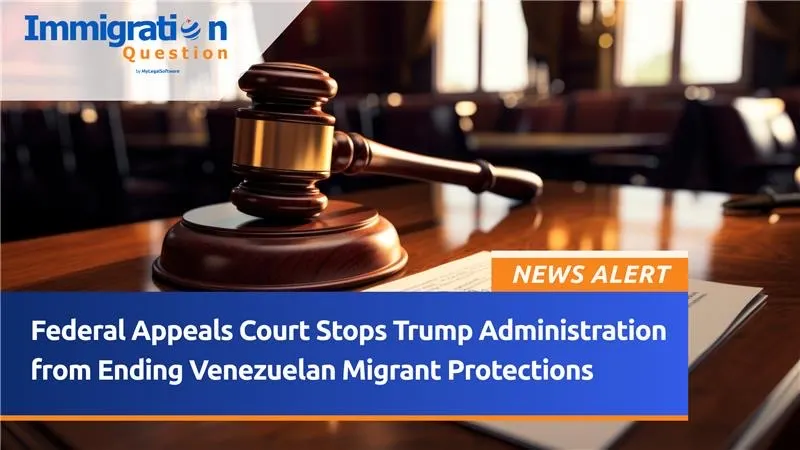
A federal appeals court has ruled that nearly 600,000 Venezuelan migrants in the United States will keep their Temporary Protected Status (TPS), blocking an effort by the Trump administration to terminate deportation protections. The decision marks a significant setback for the administration’s immigration strategy and a major victory for migrant advocates.
Court Rejects Administration’s Request
On Wednesday, a three-judge panel of the 9th U.S. Circuit Court of Appeals declined to pause a September 5 ruling from U.S. District Judge Edward Chen. Judge Chen had determined that Homeland Security Secretary Kristi Noem acted unlawfully when she revoked TPS for Venezuelans earlier this year.
The panel of appeals emphasized that revocation of TPS would place Venezuelan immigrants at risk of unjust deportation, family separation, and loss of jobs. It further noted that Congress never envisioned that TPS would be revoked in this manner, showing that the administration had exceeded its authority.
Temporary Protected Status at Stake
Temporary Protected Status was launched in 1991 to protect foreign nationals against deportation when their countries are experiencing armed conflict, natural disasters, or extraordinary circumstances. TPS not only shields individuals from deportation but also authorizes them to work, allowing recipients to work legally and join the workforce.
The program had already been expanded under President Joe Biden to cover approximately 600,000 Venezuelans and 521,000 Haitians. In February, Secretary Noem announced the reversal of those extensions, arguing that conditions no longer justified the protections and that TPS had strayed from its original intent.
Wider Implications of the Ruling
The ruling ensures Venezuelans with TPS protection remain eligible for deportation protection as well as employment permits, at least temporarily, while the larger legal fight continues. For many affected families, the ruling provides a short-term sense of security after months of uncertainty over their legal status.
By enforcing Judge Chen’s injunction, the court also reconfirmed the principle that humanitarian relief programs cannot be undermined on less than compelling legal justifications. The precedent could have an influence on future cases concerning the treatment of migrants under analogous protection programs.
Supreme Court Implications
The Trump administration argued that a May Supreme Court ruling, which allowed the termination of TPS protections for 348,000 Venezuelans, required Judge Chen’s latest decision to be put on hold. The appeals court disagreed, finding that the administration had failed to show why protections should end while litigation continues.
Following Wednesday’s ruling, the Department of Justice signaled it may again escalate the issue to the Supreme Court. A Department of Homeland Security spokesperson criticized the appeals court, calling its decision “open defiance against the U.S. Supreme Court,” but acknowledged further litigation is likely.
Impact on Haitians and Other Groups
Judge Chen’s ruling also extended protections to more than 500,000 Haitians whose TPS was revoked earlier this year. However, the administration did not challenge that part of the decision, as a separate federal judge in New York had already blocked the rollback of Haitian TPS.
Advocacy organizations, including the National TPS Alliance and the American Civil Liberties Union, welcomed the decision. They argued that the government attempted to justify the removals based on flawed reasoning and praised the court for seeing the humanitarian consequences at stake.
What Comes Next?
The ruling is emblematic of the commanding role that federal courts have played under President Trump in shaping immigration policy. While the appeals court ruling protects Venezuelan migrants from deportation in the near term, the possibility of review by the Supreme Court leaves the fate of TPS uncertain.
For affected families, the decision brings temporary relief, continuous access to work permits, and avoidance of removal. For the administration, the reversal is yet another delay in its broader effort to bolster immigration policy and limit humanitarian protections.
For more updates on U.S. immigration, visit ImmigrationQuestion.com. Get answers to your immigration questions from licensed immigration attorneys. For attorneys, use our innovative 2-in-1 case management software to grow your practice. Download our free app on Google Play and the Apple App Store.
Resources:
**ImmigrationQuestion.com is a third-party platform that serves as a meeting ground for licensed immigration attorneys and people with immigration questions. It is not a law firm. It is not affiliated with or endorsed by USCIS or AILA. Attorneys on this platform are independent and have the discretion to offer a free consultation and/or set their fees under the law.