
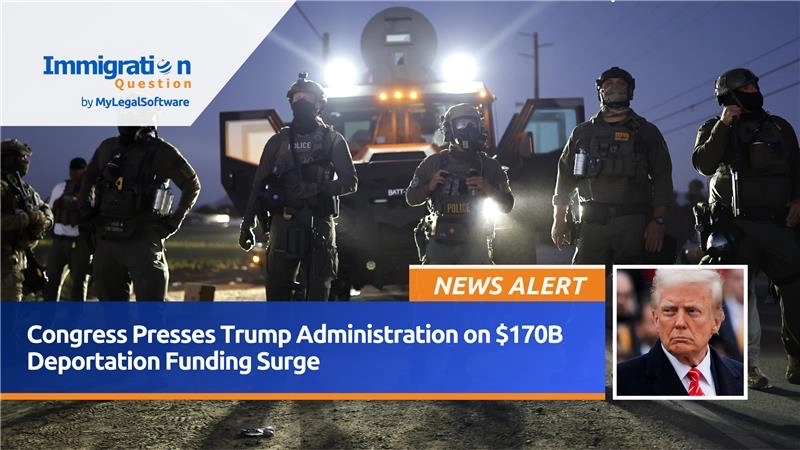
Lawmakers from both parties are scrutinizing the Trump administration’s request for a record $170 billion to power its deportation agenda, nearly doubling the Department of Homeland Security’s budget. The funding surge supports expanded raids, detention centers, and a “whole of government” approach, raising questions about oversight and constitutional limits.
Historic Boost to Homeland Security Spending
President Donald Trump’s border security team, led by former ICE Director Tom Homan, pressed Congress for sweeping resources just weeks after Inauguration Day. By midsummer, the White House had secured its goal: a massive funding increase tucked into the Republican-led tax and spending cuts bill signed on July 4.
The law allocates nearly $170 billion to the Department of Homeland Security — almost double its annual budget — making it one of the most significant single-year boosts in the agency’s history.
Funding Lacks Detailed Oversight
The bill’s text outlines broad categories for the spending—nearly $30 billion for ICE officers, $45 billion for detention facilities, and $10 billion for the office of the Homeland Security Secretary Kristi Noem — but contains few policy directives. DHS has already announced $50,000 hiring bonuses to attract new ICE recruits.
Lawmakers have also raised concerns about the administration shifting as much as $1 billion from other agencies, including the Federal Emergency Management Agency, to bolster enforcement efforts. Sen. Chris Murphy (D-Conn.) has criticized the pace of spending, warning DHS would “go broke” without tighter oversight.
Republican Committees Seek Clarity
Oversight concerns are not limited to Democrats. Rep. Andrew Garbarino (R-N.Y.), chairman of the House Homeland Security Committee, and Rep. Michael Guest (R-Miss.), who heads a key subcommittee, have formally requested a briefing on how DHS will allocate the new funds.
The request specifically asks for details on the One Big Beautiful Bill Act’s $46 billion allocation over four years for construction of Trump’s long-promised U.S.–Mexico border wall. DHS officials have said they are in daily communication with Congress to address the committee’s questions.
Expanding Deportations Beyond the Border
The expanded budget is enabling DHS to extend its operations deep into the interior of the United States. Raids have increased in residential neighborhoods, workplaces, and even college campuses. ICE has confirmed plans to house detainees at military facilities, including Fort Bliss, as part of a broader capacity expansion.
Immigration analysts describe the approach as a “whole of government” strategy, with agencies ranging from the Defense Department to the Internal Revenue Service assisting in enforcement operations. Kathleen Bush-Joseph of the Migration Policy Institute says the shift reflects an intentional move toward nationwide deportation capability rather than focusing solely on border enforcement.
Public Opinion and Political Risks
The funding surge comes at a time when public attitudes toward immigration are shifting. A recent Gallup poll found that 79% of Americans now view immigration as a positive for the country, up from 64% a year earlier. However, an AP-NORC poll shows Trump’s immigration approval rating has slipped to 43%.
Critics argue that the administration’s tactics risk alienating moderate voters by targeting immigrants without criminal records. While Trump and Homan insist deportations focus on “the worst of the worst,” advocacy groups point to numerous cases involving long-term residents with no criminal history beyond immigration violations.
Looking Ahead-New Era of Detention Infrastructure
The influx of funds is accelerating the creation of new detention facilities, from Florida’s “Alligator Alcatraz” to a converted prison in Leavenworth, Kansas. A proposed “Speedway Slammer” in Indiana is among several planned sites. ICE is also increasing the use of flights to deport migrants to Central America, Africa, and beyond.
The administration maintains that the funding is essential to delivering on Trump’s pledge for the largest domestic deportation operation in U.S. history, despite criticism over costs and constitutional implications.
For timely updates and analysis on immigration enforcement and related immigration issues, visit ImmigrationQuestion.com. Get answers to your immigration questions from licensed immigration attorneys. For attorneys, use our innovative 2-in-1 case management software to grow your practice. Download our free app on Google Play and the Apple App Store.
Resources:
- https://apnews.com/article/trump-congress-deportations-immigration-raids-homeland-security-a2c6a2f726629e62bd0199aee68294f6
- https://abcnews.go.com/US/wireStory/trumps-big-bill-powering-mass-deportations-congress-starting-124537267
- https://www.washingtontimes.com/news/2025/aug/11/donald-trumps-big-bill-powering-mass-deportations-congress-starting/
**ImmigrationQuestion.com is a third-party platform that serves as a meeting ground for licensed immigration attorneys and people with immigration questions. It is not a law firm. It is not affiliated with or endorsed by USCIS or AILA. Attorneys on this platform are independent and have the discretion to offer a free consultation and/or set their fees under the law.