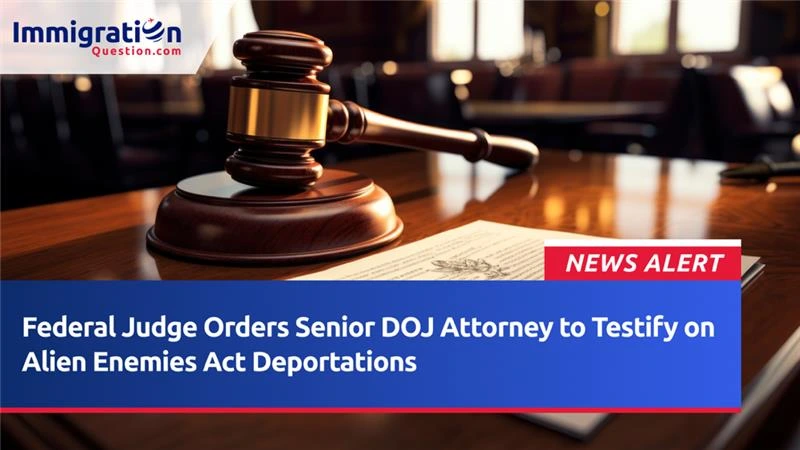
A federal judge has ordered senior Justice Department officials to testify about the administration’s March deportations conducted under the Alien Enemies Act. The directive follows ongoing disputes over why the removals proceeded despite a temporary court order blocking the flights. Testimony is scheduled for mid-December as the court examines potential noncompliance.
Federal Court Seeks Details on Decision-Making Behind March Removals
A federal judge has directed a senior Justice Department official to provide sworn testimony regarding the administration’s use of the Alien Enemies Act to deport more than one hundred individuals earlier this year. The order reflects the court’s ongoing effort to determine whether federal officials disregarded the court’s instructions regarding the removals.
U.S. District Judge James Boasberg instructed Drew Ensign, Deputy Assistant Attorney General for the Office of Immigration Litigation, to appear on December 16. He also called for testimony from former DOJ attorney Erez Reuveni, who previously asserted that the government did not comply with the court’s guidance during the March operation.
18th-Century Wartime Authority Cited as Basis for Deportations
The removals were carried out under the Alien Enemies Act, a wartime authority allowing the government to expel noncitizens with limited procedural protections. Federal officials used the statute to transfer two planeloads of detainees to El Salvador, asserting that members of the Venezuelan group Tren de Aragua represented a security threat to the United States.
Judge Boasberg issued a temporary restraining order directing that the planes be returned to U.S. custody. Justice Department attorneys later argued that the judge’s oral directive lacked legal effect and that the removals had already progressed to the point that they could no longer be reversed.
Court Examines Whether Officials Violated Orders, Declines Immediate Contempt Referral
Following the disputed removals, the court initiated proceedings to evaluate whether any federal officials intentionally ignored its directive. In his recent ruling, Judge Boasberg stated that the existing filings did not provide sufficient information to determine whether the actions taken constituted willful noncompliance.
He pointed out that a sworn declaration from DHS Secretary Kristi Noem lacked detail, so it was too early for the court to think about a criminal contempt referral. Noem stated that she continued the transfer operations based on legal advice from senior officials, including Acting DHS General Counsel Joseph Mazarra.
Government Filings Highlight Internal Legal Interpretations
In his own declaration, Mazarra wrote that he reviewed the judge’s order and advised DHS leadership accordingly. He asserted that DHS had completed the removals before any operative directive could restrict their actions. The Justice Department has denied intentionally violating the court’s instructions and has challenged the scope of the contempt inquiry.
The judge’s decision to require testimony aims to clarify how internal assessments, communications, and legal interpretations influenced the government’s decision to proceed with the deportations. The hearings in mid-December should reveal the sequence of events related to the disputed operation.
Looking Ahead
Testimony from senior Justice Department officials is set for December 15 and 16. Legal observers believe the hearings will impact how courts address future disputes involving emergency removal powers and possible conflicts between agency actions and court orders. More filings are expected as the case progresses.
For continued updates, detailed case tracking, and community discussions, visit ImmigrationQuestion.com.
Get answers to your immigration questions from licensed immigration attorneys. For attorneys, use our innovative 3-in-1 case management software to improve your practice. Download our free app on Google Play Store and the Apple App Store.
Resources:
**ImmigrationQuestion.com is a networking platform founded by Immigration Attorneys. It serves as a meeting ground for licensed immigration attorneys and people with immigration questions. It is not a law firm. It is not affiliated with or endorsed by USCIS or AILA. Attorneys on this platform are independent and have the discretion to offer a free consultation and/or set their fees under the law.