You might know you’re a U.S. citizen, but unless you can prove it, that citizenship can feel like it’s hanging in limbo.
That’s why you need Form N-600. This form is how you can get an official Certificate of Citizenship from the government, whether you’re a U.S. citizen by birth through your parents or filing on behalf of your child.
It’s not the same as applying for citizenship; it’s about confirming what already belongs to you or your child.
In this guide, we’ll break down everything you need to know about USCIS Form N-600: who should file, how to complete it, and how to avoid costly mistakes.
What Is Form N-600?

The N-600 form is the official U.S. immigration form used to request a Certificate of Citizenship for individuals who already have a claim to U.S. citizenship through their parents. This is not the form to apply for naturalization (that’s Form N-400). Instead, Form N-600 confirms and documents your status as a U.S. citizen.
With N-600, you’re not becoming a citizen; you’re proving that you already are a citizen.
The citizenship application form N-600 is often used by U.S. citizen parents applying for documentation for a child born abroad, or by individuals who acquired or derived citizenship through their parents.
Who Should File Form N-600?

You should consider filing the N-600 form if:
- You’re a U.S. citizen parent, and your child was born outside the U.S. but automatically acquired U.S. citizenship at birth or after lawful admission.
- You’re an individual who acquired or derived citizenship through your parents and now need proof.
The N-600 form is particularly common in cross-border families. Even if a child never lived in the U.S., they may still be a citizen if one or both parents held U.S. citizenship at the time of birth.
It’s also useful for adopted children in certain circumstances, though additional legal steps may be required.
What are the Eligibility Requirements?

Eligibility depends on a mix of laws that have changed over the years, so it’s important to understand the details. Generally, you must meet the following:
- The person must be under 18 years old when they acquire citizenship.
- At least one parent must be a U.S. citizen, either by birth or naturalization.
- The child must be legitimate or legally adopted, if applicable.
- The child must reside in the United States in the legal and physical custody of the U.S. citizen parent, unless exceptions apply.
Derivative citizenship means it was acquired after birth (usually when a parent naturalized), while acquired citizenship means the individual was a citizen at birth. Both categories may qualify, but the citizenship law in effect at the time of birth or naturalization matters.
How to Complete USCIS Form N-600

Filling out USCIS Form N-600 requires attention to detail. The form N-600 application for certificate of citizenship is divided into multiple sections, including:
- Information about the applicant (the person seeking the certificate)
- Information about the U.S. citizen parent(s)
- Details on the applicant’s birth and any prior immigration status
- Supporting evidence for how the citizenship was acquired or derived
You’ll also need to attach proof, such as birth certificates, passports, and evidence of the parents’ U.S. citizenship.
When completing the citizenship application form N-600, make sure all information matches official documents. Even small discrepancies (like name spelling differences) can cause delays or RFEs (Requests for Evidence).
How to File Form N-600

You can file Form N-600 online through the USCIS portal or by mail. Filing online lets you upload supporting documents, track your case, and receive status updates faster.
If you choose to file by mail, you’ll have to send your USCIS Form N-600 and supporting documents to the lockbox address listed on the USCIS N-600 instructions page.
Note that the filing fee is $1,385 for paper filing and $1,335 for online filing (as of July 2025). Fee waivers are available for qualifying low-income applicants using Form I-912.
Whether online or by mail, ensure every document is submitted in English or includes certified translations. Missing documents can cause serious delays.
What are the Supporting Documents Required for N-600?
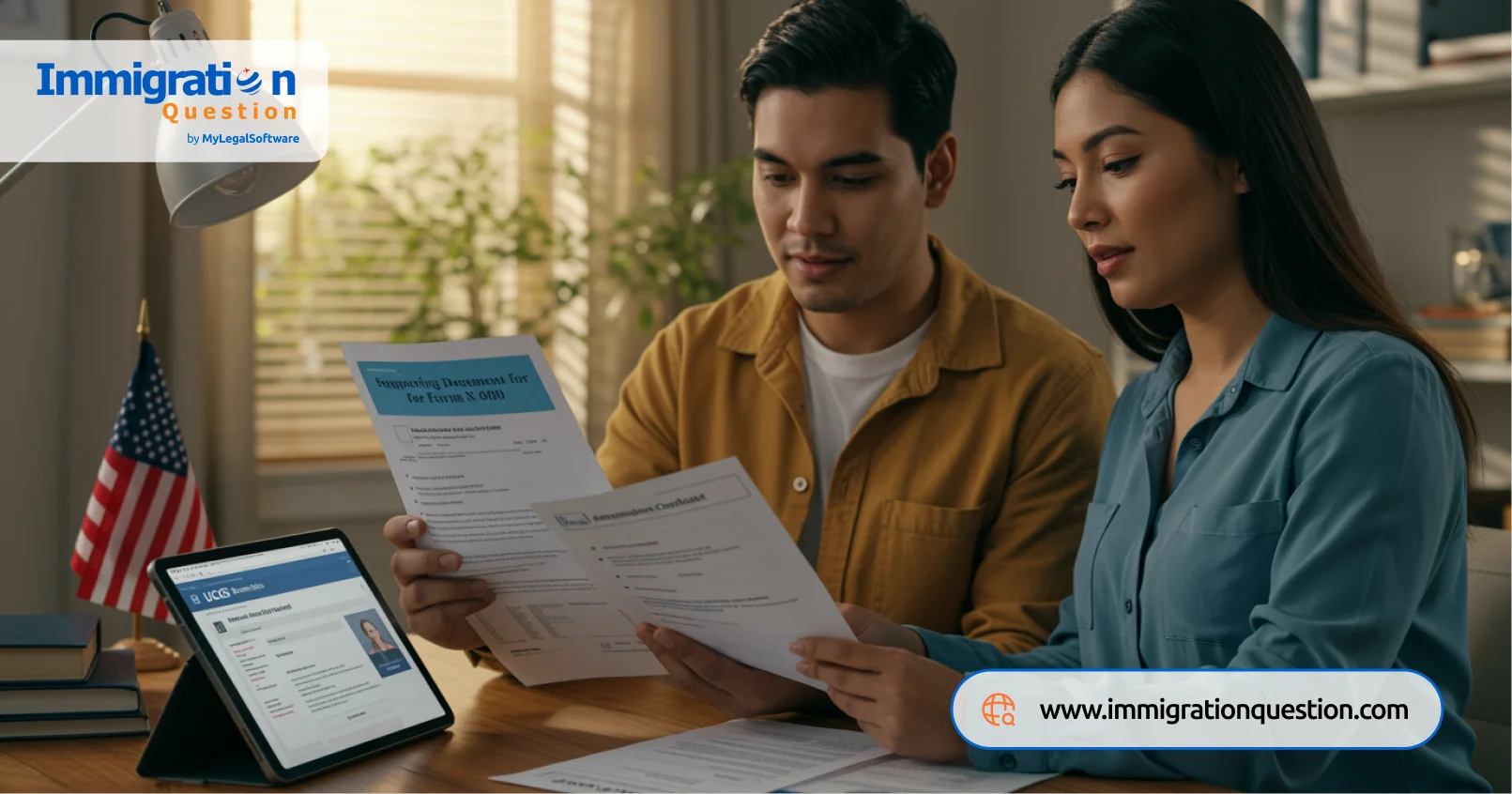
To prove eligibility for the Form N-600 certificate of citizenship, you must submit:
- Proof of the parents’ U.S. citizenship (e.g., naturalization certificate or U.S. passport)
- Child’s birth certificate
- Marriage certificate (if applicable) to establish the parental relationship
- Evidence of legal custody or guardianship (for adopted or separated parents)
- Proof of physical presence or residence of the U.S. citizen parent, as required by the applicable law
- Legal adoption decree (if filing for an adopted child)
All documents must be legible and, if applicable, translated into English. Submitting incomplete or inaccurate documents may lead to delays or a Request for Evidence (RFE).
Processing Time and What to Expect

The average processing time for Form N-600 varies by USCIS workload but typically ranges from 6 to 12 months. After submitting your application, you’ll receive a receipt notice confirming USCIS has accepted your U.S. immigration form N-600.
If additional evidence is needed after filing, you may receive an RFE (Request for Evidence). In rare cases, USCIS may schedule an interview, especially if questions about the parent-child relationship or custody arise.
You can check your case status online using the receipt number provided. If you download and complete the N-600 form PDF, make sure all hand-filled sections are legible and accurate before submitting to avoid delays.
What Happens After Approval?

Once approved, you’ll receive the official Certificate of Citizenship—a permanent legal document that proves U.S. citizenship. This certificate holds the same legal weight as a U.S. birth certificate or naturalization document.
Unlike applicants who go through naturalization, recipients of an approved citizenship form N-600 already hold citizenship through their parents and do not need to take an oath. With the certificate, they can apply for a U.S. passport, register to vote (if eligible), and access all rights reserved for U.S. citizens.
What are the Common Mistakes to Avoid?

Filing Form N-600 comes with several common potential mistakes:
- Submitting Form N-400 instead of the correct citizen form N-600
- Failing to prove that the U.S. citizen parent met the physical presence requirements
- Omitting custody documents for adopted or separated families
- Not signing the form or missing pages during upload
- Submitting unverifiable translations of foreign documents
Review all instructions thoroughly before filing.
N-600 is More Than Just Paperwork: Get Help

The Form N-600 application for certificate of citizenship isn’t just an immigration form; it’s confirmation of an already existing right to U.S. citizenship. For many families, especially those with children born abroad or adopted from another country, securing that certificate is essential for peace of mind and access to full legal protections.
Because eligibility can hinge on important details like lawful custody, step-parent relationships, or how the citizenship law applied at the time of birth, it’s important to get this application right.
If you’re unsure about eligibility or the application process, platforms like ImmigrationQuestions.com can provide answers and even help connect you for free with licensed immigration lawyers who specialize in citizenship filings. From assessing complex parental histories to resolving RFEs, professional guidance can save you time and stress.
Frequently Asked Questions
1. What is Form N-600 used for?
To get official, permanent recognition of your citizenship status, which means access to a U.S. passport and full legal rights.
2. What is the difference between Form N-600 and Form N-400?
Form N-600 is used to claim existing U.S. citizenship. Form N-400 is for applying for naturalization, which allows you to become a citizen after meeting residency requirements.
3. Can I file Form N-600 online?
Yes, USCIS allows Form N-600 to be filed online using your USCIS account.
4. Do I need a lawyer to file Form N-600?
Not required, but legal guidance is helpful if your case involves adoption, complex custody, or international birth scenarios.