
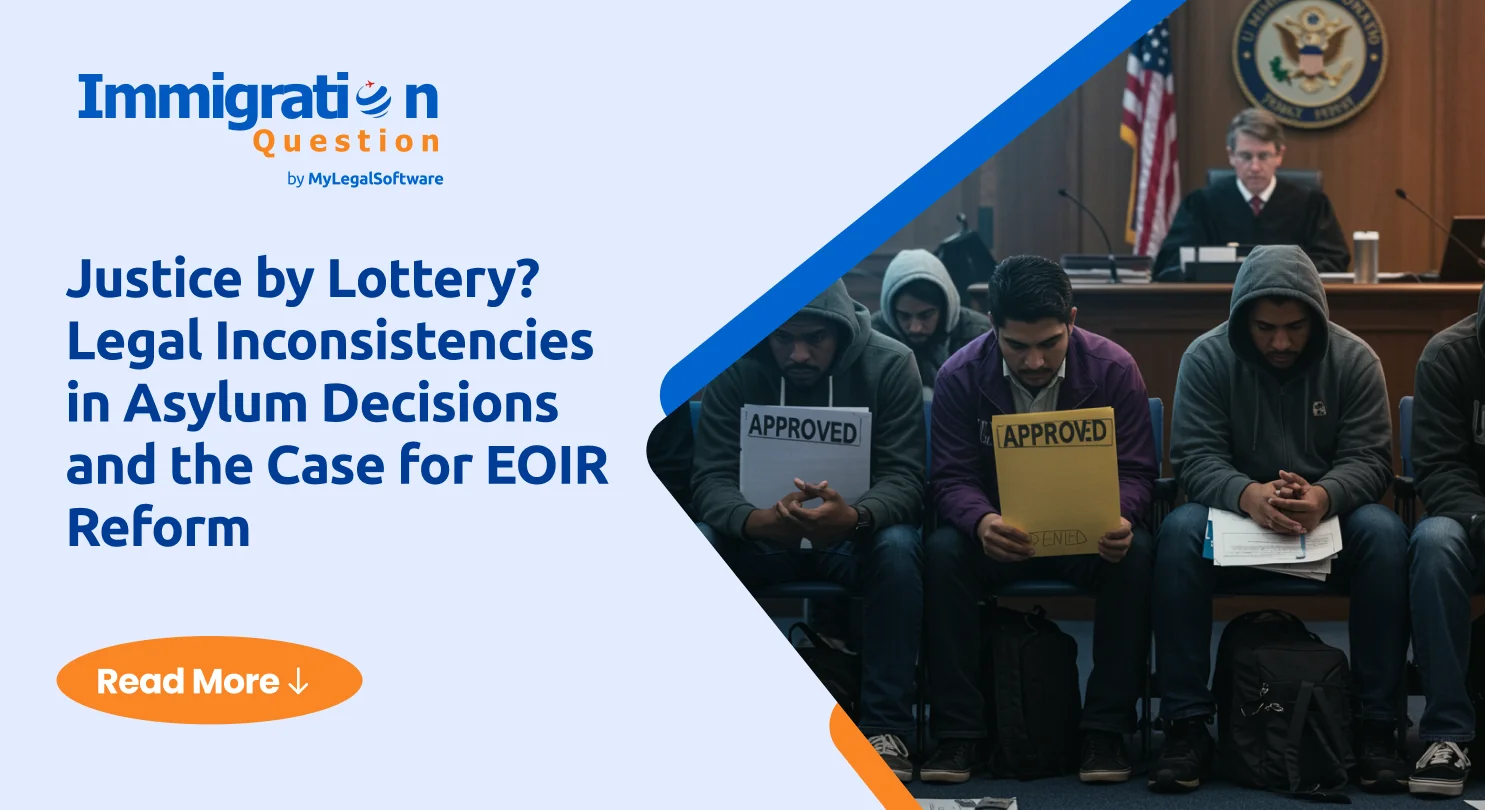
Imagine fleeing political persecution, crossing continents for safety, gathering every piece of evidence you can, only to be told “no”. Not because your story wasn’t true. Not because your life wasn’t in danger. But because of which judge you happened to face that day.
This isn’t an exaggeration. It’s the quiet crisis in America’s immigration courts.
Each year, thousands of asylum seekers put their fate in the hands of Immigration Judges (IJs) across the country. But study after study reveals a jarring fact: the chances of winning asylum often depend less on the merits of a case and more on judicial assignment, courtroom culture, and geographic location.
It’s not justice. It’s a lottery. And it’s time for legal reform.
1. How the Same Story Gets Two Different Results
You’d think two people fleeing the same regime, presenting similar facts, would receive similar outcomes. But a 2023 Stanford Law Review analysis revealed that asylum grant rates vary dramatically between judges—even within the same courthouse. One judge might grant asylum 80% of the time, while the one in the courtroom next door denies 90% of claims.
The EOIR’s own data confirms this. And it’s not just by chance—it’s structural.
2. The Hidden Role of Bias and Burnout
Many immigration judges are overwhelmed. The backlog has soared beyond 2 million cases. Judges may handle 30–40 cases per week, without clerks or sufficient breaks. But that’s not all.
Former ICE attorneys are disproportionately represented on the bench, and political appointments during previous administrations led to judges with low asylum grant histories becoming trainers, supervisors, or appellate reviewers.
Worse still, some judges reportedly refer to asylum applicants using dismissive terms, or outright express skepticism of trauma narratives, especially those involving women, or non-English speakers.
This is not just bias. It’s a breakdown in legal neutrality.
3. When Credibility Standards Become a Weapon
One of the sharpest legal tools against asylum seekers today is credibility assessment. Judges can deny an application if they find “inconsistencies” in an applicant’s account, even minor ones, like date mix-ups or emotional retellings that vary over time.
But trauma doesn’t produce perfect memory. Nor does being interrogated through interpreters in high-stress settings.
What results is a deadly paradox: applicants are told to tell their full story, but are penalized if that story doesn’t sound rehearsed or robotic.
4. What Legal Paths Can (and Should) Be Taken
The issue isn’t lack of legal structure—it’s the lack of enforced standards. Here’s what legal advocates are calling for:
National Guidelines for Credibility Assessments
Clear, trauma-informed protocols must be introduced. Judges should receive mandatory training in evaluating testimony without cultural or emotional bias.
Judicial Data Transparency
All IJ asylum grant rates should be public, searchable, and regularly reviewed—by EOIR and Congress. Outliers must be investigated.
Randomized Panel Reviews
Just like appeals courts use multi-judge panels, EOIR could implement peer-review auditing for extreme cases of grant/denial imbalance.
Independent Court Status
EOIR remains under the Department of Justice—meaning immigration judges are technically Justice Department employees. Legal organizations have long called for EOIR to become an independent Article I court, free from political influence.
5. Legal Advocates: What You Can Do Now
1. Know Your Judge
Legal teams representing asylum seekers are encouraged to review the historical grant rates and decision patterns of assigned immigration judges. While each case should be evaluated on its own merits, this information can provide valuable context to guide case preparation and client expectations.
2. Build Judicial Watchdogs
Immigration advocacy organizations and legal institutions can help promote transparency by gathering and sharing anonymized data on immigration court decisions. Identifying broader trends may support efforts toward more consistent and equitable adjudication.
3. File Strategic Appeals
When asylum claims are denied based on questionable credibility assessments or unusually strict interpretations, legal teams should consider filing appeals with the Board of Immigration Appeals or federal courts. These appeals help maintain oversight and reinforce due process protections.
4. Push for Legislative Reform
Continued advocacy is essential to strengthen the structure and independence of the immigration court system. Legal professionals and stakeholders can support legislative efforts to clarify procedures, establish stronger oversight, and reduce political influence in asylum adjudication.
Final Thoughts: A Legal System Built on Luck Isn’t a Legal System
The phrase “refugee roulette” isn’t just academic—it’s real life. A single judge’s decision can determine whether someone fleeing persecution finds safety or is sent back into danger. And if the law can’t guarantee fairness at the very least, it’s failing the people it’s meant to protect.
The EOIR is long overdue for reform. The urgency is clear, but so are the solutions. Fairness, consistency, and judicial independence aren’t radical demands—they’re the foundation of justice. For legal professionals, advocates, and allies, the path forward is clear: expose the inconsistencies, challenge the unjust decisions, and help build a system where justice isn’t left to chance.
Whether you’re navigating legal limbo, responding to a sudden policy shift, or simply need answers you can trust, at ImmigrationQuestion.com our network of licensed immigration attorneys is here to help you get answers to tough questions, often within hours.
No matter where you are in the world, you deserve clarity, protection, and peace of mind. Don’t wait for a crisis—visit ImmigrationQuestion.com today to get the legal answers you need and, in some cases, a free consultation session with an immigration attorney.