
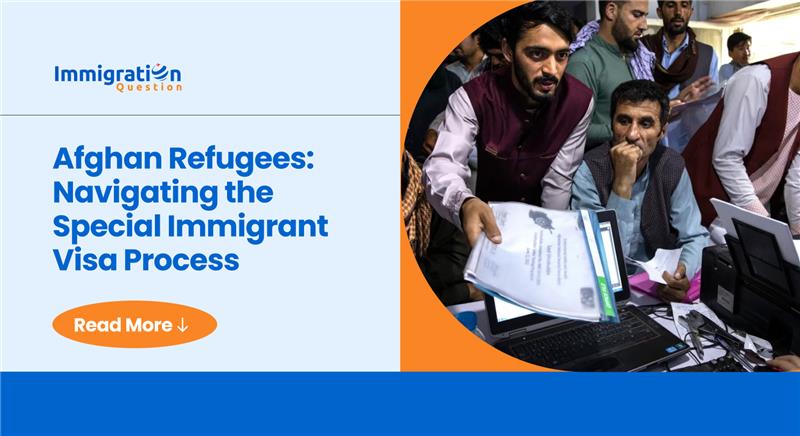
The Afghan Special Immigrant Visa (SIV) is for certain Afghan nationals who supported U.S. missions through qualifying service. If approved, it leads to lawful permanent residence and may later support applying for U.S. citizenship. Requirements and deadlines can change, so verify current official instructions before filing.
What Is the Afghan Special Immigrant Visa (SIV)?
The Afghan Special Immigrant Visa (SIV) is a special immigrant pathway for Afghan nationals who worked for or on behalf of the U.S. government or supported U.S. operations in Afghanistan.
It exists to provide a protection-based, permanent immigration option tied to that service. If approved, the applicant becomes a lawful permanent resident and may later pursue U.S. citizenship through the normal naturalization process.
Who Qualifies for the Afghan Special Immigrant Visa?
Interpreters and translators who supported U.S. armed forces or qualifying U.S. operations
Individuals employed by or on behalf of the U.S. government, ISAF, or a successor mission in Afghanistan
Applicants whose eligibility is confirmed through Chief of Mission (COM) authority
Afghan SIV is service-based and is different from refugee programs. Refugee processing under USRAP is based on humanitarian protection needs, such as an individual referral (P-1) or a group designation (P-2), and it does not require U.S. government employment.
Afghan SIV Eligibility Requirements
- Afghan nationality
- Qualifying employment (for or on behalf of the U.S. government, ISAF, or a successor mission)
- Length of service (with dates): at least 1 year of qualifying service during the covered period, described as October 7, 2001, through December 31, 2023
- Letter of Recommendation
- COM approval
- Application deadline: COM application deadline listed as December 31, 2025
Afghan Special Immigrant Visa Application Process (Step by Step)
- Pre-COM application: Gather identity and employment evidence and submit the required package for COM review through the Department of State.
- Chief of Mission approval: The COM review confirms service-based eligibility and is required before later steps.
- Visa petition and interview: After COM approval, proceed to immigrant visa processing and a U.S. embassy or consulate interview outside Afghanistan, as applicable.
- Security and medical vetting: Complete security screening and medical steps with agencies including DOS and DHS.
- Entry to the United States as a lawful permanent resident: If issued an SIV and admitted, the recipient enters as a lawful permanent resident.
Afghan SIV Deadline and Current Status
Official guidance listed December 31, 2025 as the deadline to apply for COM approval. It has also listed June 5, 2026 as the deadline to submit all supporting documentation for a COM application, including additional documentation requested by the Department.
Recent policy announcements have affected visa issuance for Afghan nationals in some contexts, so applicants should treat timelines as changeable and verify the latest updates using official sources. Always check the latest official sources again before filing.
Afghan SIV vs Refugee Programs (USRAP, P-1, P-2)
| Program | Based On | Employment Required | Leads to Green Card |
| Afghan SIV | U.S. government service | Yes | Yes |
| P-1 Refugee | Individual referral based on protection needs | No | Yes |
| P-2 Refugee | Group designation for access | No | Yes |
SIV is tied to documented U.S.-connected service and COM review. P-1 and P-2 are refugee access categories focused on protection needs and do not require U.S. government employment.
Afghan Resettlement Support and Operation Enduring Welcome
After entry, SIV recipients may be connected to resettlement support that helps with initial reception and longer-term integration. Operation Enduring Welcome has been described as a U.S. government effort to relocate and resettle eligible Afghan allies.
Initial resettlement assistance may include arrival coordination, temporary support services, and help connecting to local community partners.
Long-term integration support often includes help navigating benefits and services, work readiness, and long-term stability.
Common Challenges Afghan SIV Applicants Face
- Missing documentation, especially employment verification and recommendation letters
- Delays in COM review due to volume and verification demands
- Security vetting timelines that can extend processing
- Family derivative issues, such as proving relationships and managing documentation
Key Takeaways
- Afghan SIV is a service-based pathway that can lead to lawful permanent residence.
- Eligibility is distinct from refugee programs and relies on qualifying service and COM review.
- Evidence for nationality, employment, and recommendation letters is central to the case.
- Deadlines and procedures can change, so official guidance should be checked before filing.
- After admission as a permanent resident, an SIV recipient may later apply for U.S. citizenship if eligible.
For more immigration guidance and resources, visit ImmigrationQuestion.com.
Frequently Asked Questions About Afghan Special Immigrant Visa
1. Who qualifies for the Afghan Special Immigrant Visa?
Afghan SIV is generally for Afghan nationals who worked in qualifying roles supporting the U.S. government or U.S. missions in Afghanistan. Eligibility is tied to documented service and COM review, not the refugee definition.
2. What documents are required for Afghan SIV?
Common documents include proof of Afghan nationality, proof of qualifying employment, and a letter of recommendation, plus the materials required for COM review. Use official instructions as the checklist because document requirements can vary by case.
3. Is the Afghan SIV different from refugee status?
Yes. SIV is based on U.S.-connected service and uses COM review and immigrant visa processing. USRAP P-1 and P-2 are refugee access categories based on protection needs and do not require U.S. government employment.
4. Does Afghan SIV lead to U.S. citizenship?
Afghan SIV recipients are admitted as lawful permanent residents, and that status can later support an application for U.S. citizenship after meeting residence and other rules. Citizenship is not automatic and requires a separate filing and review.
5. Do family members qualify under Afghan SIV?
Yes. A spouse and unmarried children under 21 can generally be included as derivative family members under Afghan SIV. Each family member still must meet relationship and admissibility requirements, and missing documents can slow processing.