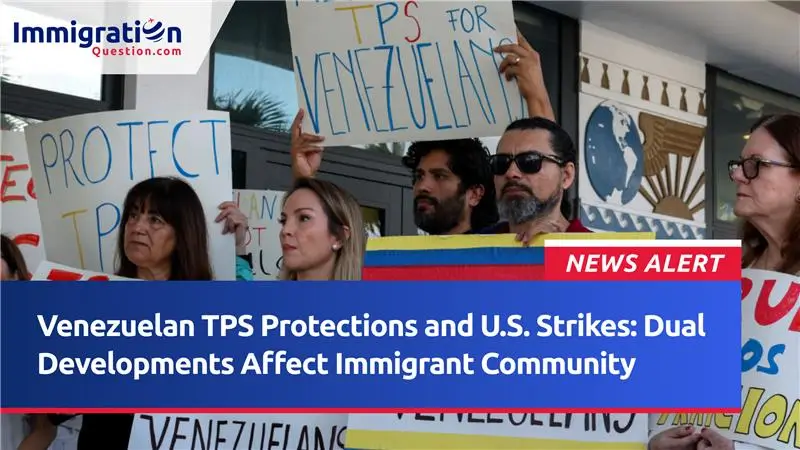
The United States executed significant military operations in Venezuela as legal battles continue over the government’s attempt to terminate Temporary Protected Status (TPS) for Venezuelan nationals living in the U.S. The overlapping developments raise international tensions while leaving hundreds of thousands of Venezuelans in legal uncertainty about their immigration status.
U.S. Military Action in Venezuela Escalates Tensions
The U.S. carried out significant military strikes across Venezuela in an escalation of pressure against the administration of President Nicolás Maduro, with explosions reported in Caracas and other regions. The claims that the actions mark a continuation of U.S. efforts to target alleged drug-trafficking networks and Venezuelan military infrastructure.
President Donald Trump described the strikes as part of larger efforts to hold Maduro accountable and disrupt drug operations. In response, Venezuela’s government condemned the actions as unlawful aggression and declared a state of emergency. Internationally, Latin American leaders criticized these actions and called for diplomatic intervention.
TPS Legal Battles Continue in U.S. Courts
At the same time, federal courts are navigating complex litigation over the Trump administration’s efforts to end Temporary Protected Status designations for Venezuelan nationals residing in the United States. TPS offers protection from deportation and work authorization for eligible individuals whose home countries are unsafe.
Recently, courts have blocked attempts to end TPS for hundreds of thousands of Venezuelan immigrants, allowing them to keep their protections while litigation continues. A federal ruling specifically prevented DHS from stripping approximately 350,000 Venezuelans of status and work authorization, keeping the protections in place during the legal process.
The status of many Venezuelan Temporary Protected Status holders has remained under legal scrutiny since the Trump administration moved to end the 2021 and 2023 TPS designations. The U.S. Supreme Court has permitted the federal government to proceed with the termination of the 2023 designation after lifting a lower court injunction. However, ongoing challenges in lower courts continue to delay full implementation, leaving the legal status of some beneficiaries unresolved.
Implications for Venezuelan immigrant communities
These developments may have significant consequences for Venezuelan immigrants and their families. For many, the potential loss of TPS protections threatens legal stability, employment authorization, and protection from removal. For others, particularly those with more recent approvals or temporary extensions, protections may remain in place for now, but only until the courts reach a final determination.
Advocates argue that ending TPS suddenly could destabilize communities that have fled instability, economic collapse, and violence in Venezuela. Critics of the policy changes have raised humanitarian issues and questioned whether the law treats everyone equally. Litigation in the federal courts continues to shape the future of these protections.
Looking Ahead
The connection between U.S. military actions in Venezuela and domestic immigration policy disputes highlights rising geopolitical and legal tensions. Courts are likely to keep hearing challenges to efforts to end TPS for Venezuelan nationals, and immigration advocates are closely monitoring outcomes that impact work authorization, deportation protections, and family stability.
Visit ImmigrationQuestion.com for continued monitoring of developments involving TPS litigation, military actions in Venezuela, and policy impacts on immigrant communities.
Get answers to your immigration questions from licensed immigration attorneys. For attorneys, use our innovative 3-in-1 case management software to improve your practice. Download our free app on Google Play Store and the Apple App Store.
Resources
**ImmigrationQuestion.com is a networking platform founded by Immigration Attorneys. It serves as a meeting ground for licensed immigration attorneys and people with immigration questions. It is not a law firm. It is not affiliated with or endorsed by USCIS or AILA. Attorneys on this platform are independent and have the discretion to offer a free consultation and/or set their fees under the law.