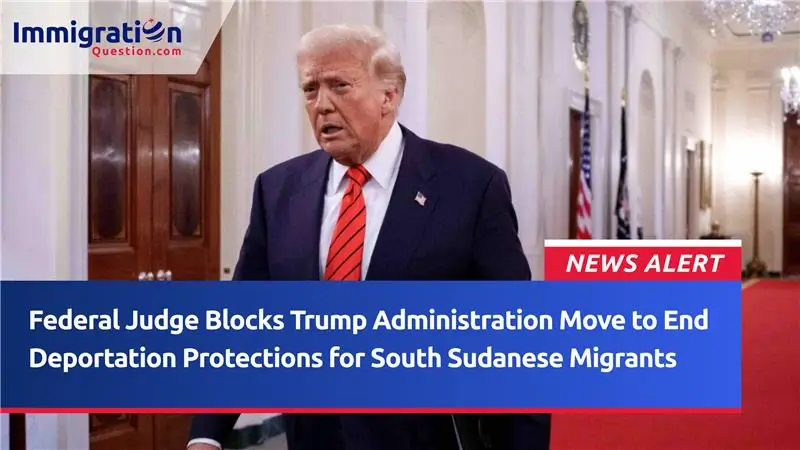
A federal judge has temporarily blocked the Trump administration’s plan to end deportation protections for South Sudanese migrants living in the United States. The ruling prevents the expiration of Temporary Protected Status, preserving lawful status and work authorization while the court reviews the termination.
Court Issues Emergency Stay on TPS Termination
A U.S. district judge in Massachusetts has blocked the Trump administration’s effort to end Temporary Protected Status for South Sudanese nationals, granting emergency relief to migrants facing potential loss of lawful status and deportation.
U.S. District Judge Angel Kelley issued an administrative stay preventing the Department of Homeland Security from allowing TPS protections to expire after January 5. The order temporarily halts the policy while litigation continues, preserving existing protections for current beneficiaries.
The lawsuit was filed by four South Sudanese immigrants and the African Communities Together, a non-profit advocacy group. The plaintiffs argued that the DHS was operating illegally by terminating the protection of TPS benefits without taking into consideration the ongoing crisis accompanying the South Sudanese immigrants.
Legal Battle Foci Include Humanitarian Issues and Statutory Requirements
In her decision, Justice Kelley explained that allowing this policy to go into effect while this litigation is ongoing would have an immediate and profound impact on South Sudanese nationals currently protected under this program. These individuals would have their legal status revoked through TPS expiration, making deportation inevitable.
The lawsuit argues that DHS violated the statute governing the TPS program by concluding that South Sudan no longer meets eligibility requirements. Plaintiffs also contend that the decision ignored the ongoing armed conflict, political instability, and humanitarian conditions in the country.
South Sudan has faced prolonged violence since gaining independence in 2011. Although a civil war formally ended in 2018, fighting has continued in parts of the country, and the U.S. State Department currently advises against travel there.
Administration Pushback and TPS Background
The Department of Homeland Security responded critically to the ruling. A DHS spokesperson stated that the court’s decision failed to recognize the administration’s constitutional and statutory authority over immigration policy and emphasized that TPS was not intended to function as a permanent immigration solution.
The United States first designated South Sudan for TPS in 2011. The program is designed to provide temporary protection from deportation and work authorization to nationals of countries facing armed conflict, natural disasters, or other extraordinary conditions.
According to the lawsuit, about 232 South Sudanese nationals currently benefit from TPS, with an additional 73 applications pending. DHS Secretary Kristi Noem published a notice on November 5 formally terminating the designation, stating that conditions in South Sudan no longer justified continued protection.
Looking Ahead
The ruling represents a temporary setback for the administration’s broader effort to scale back humanitarian immigration programs. It is part of a wider series of court challenges involving TPS designations for multiple countries. Further litigation will determine whether the TPS termination can proceed. Until then, protections for South Sudanese beneficiaries remain in place under the court’s order.
For continued monitoring of TPS litigation, federal court rulings, and policy developments affecting humanitarian immigration programs, visit ImmigrationQuestion.com, a meeting ground for individuals seeking clarity on U.S. immigration policy.
Get answers to your immigration questions from licensed immigration attorneys. For attorneys, use our innovative 3-in-1 case management software to improve your practice. Download our free app on Google Play Store and the Apple App Store.
Resources:
**ImmigrationQuestion.com is a networking platform founded by Immigration Attorneys. It serves as a meeting ground for licensed immigration attorneys and people with immigration questions. It is not a law