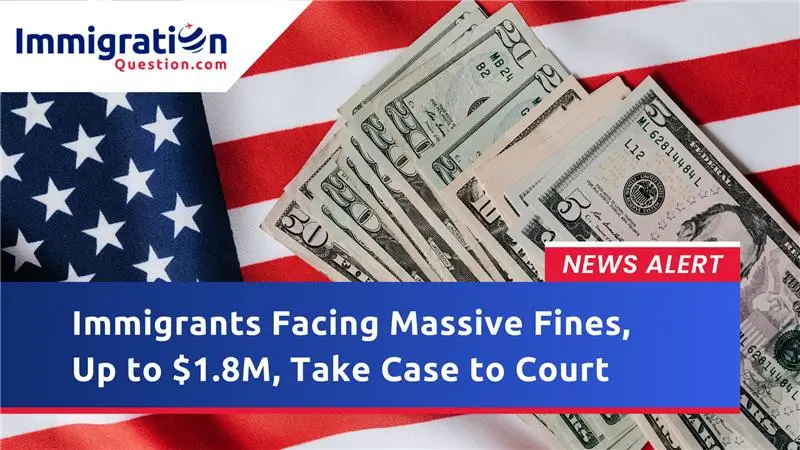
Federal immigration enforcement is facing new scrutiny after a team of lawyers filed a lawsuit on behalf of immigrants who have been issued crushing civil fines that can reach up to $1.8 million per person. The suit, brought on Thursday in a Massachusetts federal court, challenges a penalty system that imposes daily fines of $998 on people who remain in the country without authorization. This system has already affected more than 21,500 immigrants this year.
A Financial Pressure Campaign
According to attorneys involved in the case, the fines are designed to force immigrants to leave the United States, even when many of them are actively trying to comply with immigration rules. Lawyers say the penalties have already totaled more than $6 billion since President Donald Trump returned to office and launched a renewed crackdown earlier this year.
Immigrants following supervision orders, attending required check-ins, and attempting to resolve their cases through immigration courts have described receiving sudden bills demanding hundreds of thousands, even millions of dollars. One of the two plaintiffs in the lawsuit had been checking in annually with immigration authorities in Florida while pursuing permanent residency. Earlier this year, she received a notice stating she owed roughly $1.8 million, calculated from accumulated daily fines over several years.
Attorneys handling the case argue that the fines are wildly disproportionate to any alleged violations and amount to unconstitutional punishment. They warn that many immigrants now face the threat of wage seizures, loss of vehicles, or even loss of their homes.
Federal Response Dismisses Concerns
Federal officials have rejected the lawsuit’s claims, characterizing it as an effort to undermine longstanding immigration law. The Department of Homeland Security has insisted that the fines are lawful tools to enforce departure requirements and maintain that individuals named in the suit are seeking to remain in the country without consequence.
The administration has been clear about its stance. In February, DHS’s secretary warned that immigrants without legal status could face significant financial penalties if they did not leave voluntarily. They emphasized that the government intended to enforce all applicable immigration laws without exception.
A Broader Strategy Emerges
The fines appear to be part of a wider effort adopted soon after the new administration took office. The message from Washington has been consistent: those without legal status should leave immediately. Advocates say this signals a dramatic escalation in how financial pressure is being used to push immigrants out of the country, even when they are actively participating in the legal process.
Immigration groups involved in the lawsuit argue that the policy punishes people for doing exactly what the system asks, such as attending appointments, filing paperwork, and seeking relief through official channels.
What Happens Next
A legal team is seeking class-action status, which could extend protections to tens of thousands of immigrants currently facing daily fines. If granted, the case may set the boundaries for how aggressively financial penalties can be used in immigration enforcement.
For now, immigrants caught in this system are left to navigate extraordinary financial demands while still trying to resolve their legal status.
At ImmigrationQuestion.com, we will continue tracking this case and its implications for immigrant communities across the country. We remain committed to providing clear reporting and ongoing analysis.
For additional immigration news and analysis, check ImmigrationQuestion.com.
Get answers to your immigration questions from licensed immigration attorneys. For attorneys, use our innovative 3-in-1 case management software to grow your practice. Download our free app on Google Play and the Apple App Store.
Resources
**ImmigrationQuestion.com is a networking platform founded by Immigration Attorneys. It serves as a meeting ground for licensed immigration attorneys and people with immigration questions. It is not a law firm. It is not affiliated with or endorsed by USCIS or AILA. Attorneys on this platform are independent and have the discretion to offer a free consultation and/or set their fees under the law.