
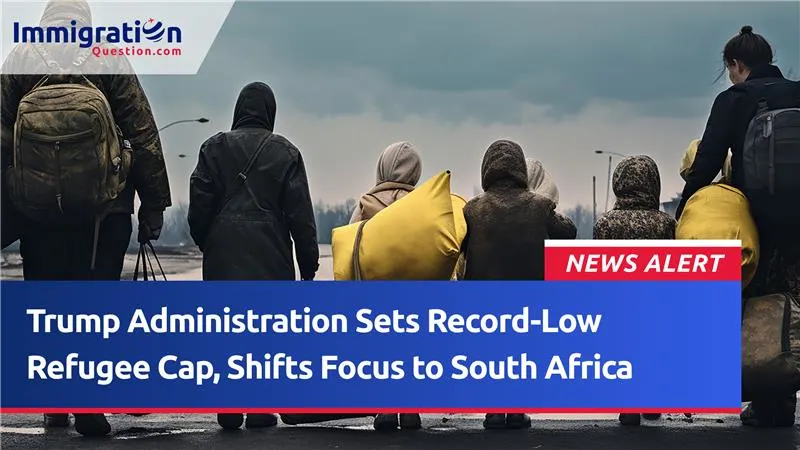
President Donald Trump has set the U.S. refugee admissions ceiling at 7,500 for fiscal year 2026 — the lowest in the nation’s history. The plan prioritizes white South Africans from the Afrikaner minority, marking a significant shift in refugee policy and drawing criticism from lawmakers and humanitarian organizations.
Record-Low Refugee Cap Announced
According to a White House document released on Thursday, the Trump administration has formally set the refugee admissions ceiling at 7,500 for the fiscal year of 2026. President Trump said the new framework would prioritize white South Africans from the Afrikaner community, citing what he described as race-based persecution in South Africa. The South African government strongly denied those claims, calling them unfounded.
Controversy Over Refugee Selection Criteria
The White House document states that preference will be given to victims of illegal or unjust discrimination in their respective countries of origin. However, internal records reviewed earlier this year indicated that U.S. officials had also considered admitting Europeans who claimed persecution for expressing political views opposing mass migration or supporting populist movements.
Humanitarian organizations and refugee advocates have sharply criticized the new policy, saying it substitutes political and racial considerations for humanitarian criteria. Fewer than 150 South Africans entered the U.S. under the refugee status last year, leading many to argue that the policy is primarily symbolic rather than based on actual need.
Lawmakers Challenge Legal Basis
Under federal law, the executive branch is required to consult with Congress before setting annual refugee limits. Several Democratic lawmakers, including Senator Dick Durbin and Representative Jamie Raskin, said on Thursday that such consultation did not occur. They described the determination as illegal and invalid, arguing that it circumvents both statutory and moral obligations.
A senior administration official attributed the delay in consultations to the ongoing federal government shutdown, which began on October 1. The official confirmed that no new refugees will be admitted until the shutdown concludes, extending uncertainty for thousands of displaced persons awaiting resettlement.
A Broader Realignment of Refugee Policy
During the United Nations General Assembly in September, senior officials from the Trump administration urged global partners to scale back asylum protections and reevaluate their refugee commitments. The administration’s position represents a sharp departure from post–World War II international norms, which emphasized shared responsibility for humanitarian protection.
In a related shift, the White House announced that oversight of refugee support programs will transfer from the State Department to the Department of Health and Human Services. The structural change is expected to limit the role of diplomacy in U.S. refugee admissions. It will place more importance on domestic management rather than international coordination.
Sharp Contrast with Previous Administrations
The new refugee ceiling is a clear shift from the levels set by earlier administrations. In fiscal year 2024, the Biden administration admitted over 100,000 refugees. With the 2026 plan, admissions would drop to less than ten percent of that number, significantly reducing the size of U.S. resettlement programs.
Humanitarian and business leaders warn that this policy could have lasting social and economic effects. They claim that refugee populations contribute to local economies, fill job gaps, and enrich U.S. communities across the nation. Advocacy groups are urging congressional hearings and legal actions to reinstate a more inclusive refugee policy.
Looking Ahead
With the record-low refugee ceiling now in place, oversight committees and humanitarian organizations are preparing for multiple legal and policy battles over the coming months. Analysts anticipate heightened debate in the coming months over the administration’s selection criteria, international commitments, and future direction of U.S. refugee policy.
For continuing coverage on refugee admissions, humanitarian resettlement updates, and congressional oversight efforts, visit ImmigrationQuestion.com.
Resources:
- https://www.reuters.com/world/us/trump-sets-refugee-admissions-ceiling-7500-fiscal-2026-lowest-cap-record-2025-10-30/
- https://www.nbcnews.com/politics/trump-administration/trump-administration-sets-refugee-admissions-fiscal-2026-lowest-record-rcna241009
- https://indianexpress.com/article/world/trump-sets-record-low-us-refugee-cap-10337361/
- https://thehill.com/homenews/administration/5581699-trump-sets-lowest-refugee-cap-in-u-s-history/
**ImmigrationQuestion.com is a third-party platform that serves as a meeting ground for licensed immigration attorneys and people with immigration questions. It is not a law firm. It is not affiliated with or endorsed by USCIS or AILA. Attorneys on this platform are independent and have the discretion to offer a free consultation and/or set their fees under the law.