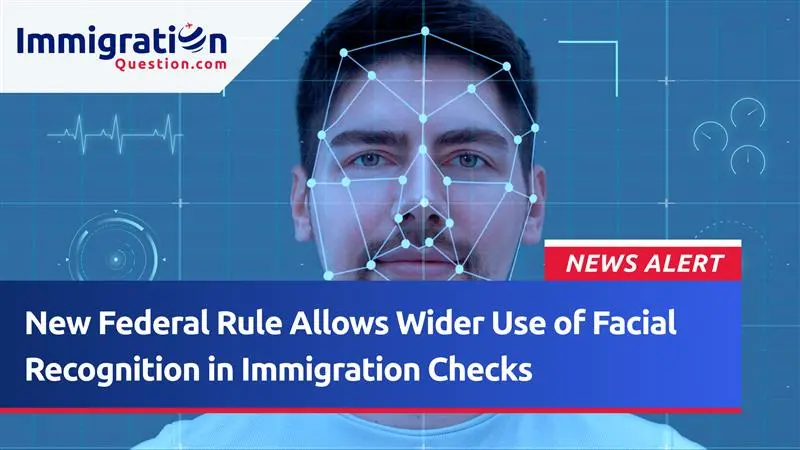
A new federal rule will permit the increased use of facial recognition and biometric data in U.S. immigration checks. Starting December 26, this measure allows border officials to take photos and collect additional biometrics from non-citizens. This significantly expands the federal government’s efforts to verify identity and enforce immigration laws.
Federal Rule Broadens Biometric Screening Authority
The Department of Homeland Security (DHS) has completed a regulation that broadens the use of facial recognition technology to identify non-citizens entering and leaving the United States. The new rule empowers U.S. border authorities to photograph travelers and collect additional biometric data, such as fingerprints or DNA, at airports, seaports, and land crossings.
Officials describe the rule as a step toward modernizing immigration checks and improving identity verification at all points of entry and departure. The policy extends an existing pilot program and aims to build a nationwide biometric entry-exit system, a goal mandated by Congress nearly three decades ago.
Rule Effective December 26 Across All Ports of Entry
Beginning December 26, U.S. Customs and Border Protection (CBP) will have full authority to require biometric submission from non-citizens, regardless of age. This change removes previous exemptions that kept children under 14 and adults over 79 from facial recognition scans.
Federal officials say the measure will enhance the accuracy of border records and aid in identifying cases of visa overstays and document fraud. The expanded scope reveals the administration’s ongoing strategy to strengthen immigration enforcement through technology, rather than relying solely on physical barriers or an increased workforce.
Focus on Visa Overstays and Identity Verification
The regulation is part of a broader federal effort to lower the number of people who overstay temporary visas. Figures from the Congressional Research Service in 2023 placed the number of about 42 percent of the 11 million illegal aliens in the United States at the time who had overstayed a visa.
By extending biometric monitoring, DHS aims to more reliably capture entries and exits and improve its ability to identify people who are in the country without authorization. The agency also maintains that biometric systems are less vulnerable to fraud and identity theft than paper-based verification systems.
Civil Rights Concerns Over Accuracy and Bias
Although federal authorities argue for increased border security through the use of biometrics, the policy has been faulted by privacy activists and civil rights groups. In its 2024 report, the U.S. Commission on Civil Rights found that facial recognition technology would identify Black and minority citizens more frequently as misidentified individuals. This raises concerns about potential errors and discrimination.
Advocates also question how biometric data will be stored and shared among federal agencies, warning of privacy risks linked to large-scale data collection. The legislation does not provide definitive data retention rules, and long-term storage and surveillance issues remain open to interpretation.
Implementation and Next Steps
According to CBP projections, a fully operational biometric entry-exit system could be in place at all commercial airports and seaports within three to five years. The system, once completed, would represent the first nationwide biometric tracking program for immigration compliance since Congress mandated such a system in 1996.
The agency has already implemented facial recognition for all commercial air entries, but only at select exit points. The new rule allows this capability to be expanded universally, completing a long-delayed aspect of federal immigration control infrastructure.
Looking Ahead
The broader use of facial recognition in immigration checks marks a turning point in the government’s approach to border and travel monitoring. Legal observers anticipate a renewed debate over data privacy and civil liberties as biometric systems become increasingly central to U.S. immigration enforcement.
For continued updates on immigration policy and enforcement developments, visit ImmigrationQuestion.com. Get answers to your immigration questions from licensed immigration attorneys. For attorneys, use our innovative 3-in-1 case management software to grow your practice. Download our free app on Google Play and the Apple App Store.
Resources:
**ImmigrationQuestion.com is a third-party platform that serves as a meeting ground for licensed immigration attorneys and people with immigration questions. It is not a law firm. It is not affiliated with or endorsed by USCIS or AILA. Attorneys on this platform are independent and have the discretion to offer a free consultation and/or set their fees under the law.