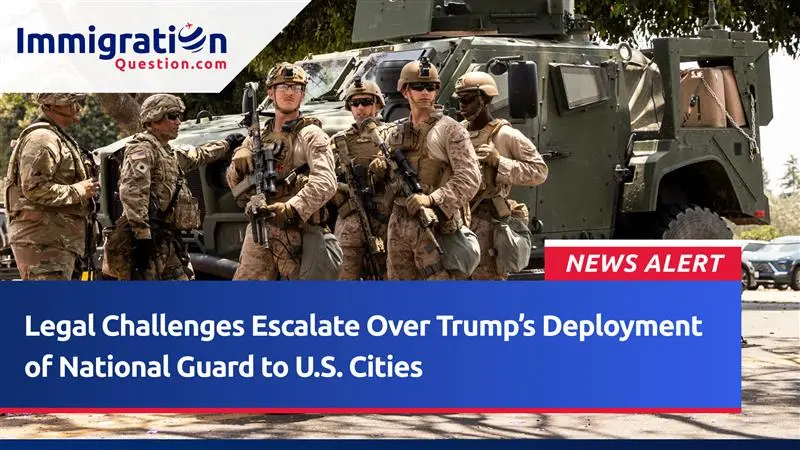
A widening series of lawsuits is testing the limits of presidential power as President Donald Trump’s deployment of National Guard troops to several U.S. cities faces mounting legal challenges. Federal and state courts from Los Angeles to Washington, D.C., are now weighing whether the controversial domestic deployments were lawful.
Los Angeles
Los Angeles was the first major city to see National Guard Troops under Trump’s order. In June, about 4,000 Guard members and 700 Marines were deployed to address protests over immigration policies. Two federal judges ruled that the deployments were unconstitutional, citing the absence of an emergency or “rebellion” that would justify federal intervention.
The courts also found that the use of troops in law enforcement roles violated the Posse Comitatus Act, which prohibits military involvement in civilian law enforcement. However, a U.S. appeals court has paused both rulings, allowing the administration’s actions to continue pending further review.
Washington, D.C.
In the nation’s capital, roughly 2,500 National Guard troops are still operating under federal command. Washington, D.C.’s unique status as a district outside state control has made it central to legal arguments over presidential authority. Local officials argue that the Guard has effectively been turned into a “federal police force.”
District Attorney General Brian Schwalb sued in September, claiming the Home Rule Act of 1973 gives the City Mayor authority over local law enforcement. The Department of Justice disputes that claim, asserting that the president retains complete control over the federal district. A hearing in the case is scheduled for today, October 24, and could determine how far federal power extends in the capital.
Chicago
In Chicago, National Guard deployments remain suspended under a temporary restraining order issued on October 9. A federal judge sided with Illinois officials who argued that federal claims of violent unrest lacked evidence, noting that local protests had been mostly peaceful.
The Trump administration has asked the U.S. Supreme Court to lift the restraining order after an appeals court upheld it. The outcome could set a national precedent for when federal troops may be deployed domestically. A Supreme Court decision is expected soon.
Portland
Portland’s case has grown increasingly complex. Trump ordered 200 National Guard troops to Oregon in late September. Still, a federal judge blocked the move, finding that his description of the city as “war-ravaged” was not supported by evidence.
A U.S. appeals court later paused that ruling, but when Trump sought to send troops from California and Texas instead, a second order again halted the deployment. Oregon’s attorney general has urged the courts to keep restrictions in place, arguing that the president’s actions overstep constitutional limits. A new hearing is set for Friday to reconsider the case.
Memphis
In Tennessee, Trump’s deployment of the National Guard to Memphis has drawn legal challenges from within the state. Unlike other cases, the troops remain under Governor Bill Lee’s control. State lawmakers and Shelby County officials sued Lee, alleging that using the Guard for civilian law enforcement violates state law and the Tennessee Constitution.
A state judge declined to suspend the deployment but scheduled a November 3 hearing to decide whether the governor acted within his authority.
Looking Ahead
As legal challenges escalate nationwide, the U.S. Supreme Court could soon define the limits of presidential authority over the domestic deployment of troops. The outcome will carry significant implications for how federal power intersects with state sovereignty during periods of civil unrest.
Stay informed on developments in immigration and federal enforcement at ImmigrationQuestion.com. Get answers to your immigration questions from licensed immigration attorneys. For attorneys, use our innovative 3-in-1 case management software to grow your practice. Download our free app on Google Play and the Apple App Store.
Resources:
- https://www.reuters.com/world/us/legal-battles-mount-over-trumps-national-guard-deployments-us-cities-2025-10-24/
- https://www.independent.co.uk/news/world/americas/trump-national-guard-portland-oregon-gavin-newsom-b2849959.html
- https://ca.news.yahoo.com/trump-portland-national-guard-deployment-135821714.html
- https://blog.immigrationquestion.com/news/national-guard-chicago-memphis-trump-2025/
**ImmigrationQuestion.com is a third-party platform that serves as a meeting ground for licensed immigration attorneys and people with immigration questions. It is not a law firm. It is not affiliated with or endorsed by USCIS or AILA. Attorneys on this platform are independent and have the discretion to offer a free consultation and/or set their fees under the law.