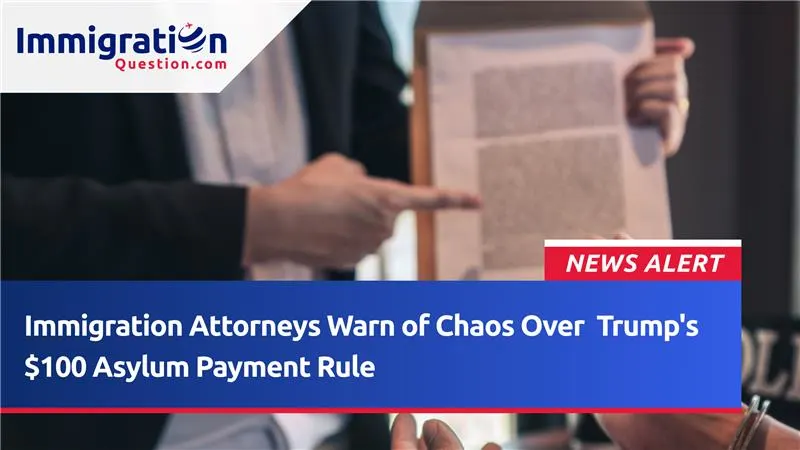
The Trump administration’s recent $100 annual asylum fee has left thousands of immigrants and lawyers scrambling to comply, as a scarcity of guidance and conflicting agency instructions drive confusion. The advocates say the rollout has the potential for inaccurate denials and deportations and turns an already complex asylum process into a bureaucratic minefield.
Asylum Fee Rollout Sets Off Widespread Confusion
The Trump administration’s new asylum fee, a $100 annual charge required of all asylum applicants, was announced in a law signed by President Donald Trump on July 4, 2025. The measure, part of a broader GOP domestic and tax package, was designed to recoup administrative costs and deter what officials call “system misuse.”
Three months after implementation, confusion remains widespread. Many immigrants say they have not received any notice or clear instructions on how to pay. According to Politico, immigration lawyers report that clients are receiving mixed messages from different agencies, with some attempting to pay through the wrong channels and others facing online payment failures.
Agency Missteps and Mixed Directives
The U.S. Citizenship and Immigration Services (USCIS) and the Justice Department’s Executive Office for Immigration Review (EOIR) initially issued contradictory guidance. While USCIS launched a payment portal, applicants report being unable to confirm transactions. EOIR, meanwhile, is yet to release its own payment system.
This inconsistency has deepened uncertainty. Some asylum seekers, keen to comply, have already paid the $100 application fee again, in the expectation that it will be credited toward the new annual charge. Attorneys warn that this will result in incorrect denials, duplicate payments, or even deportation orders for non-payment.
Legal Action and Federal Justification
The Asylum Seeker Advocacy Project (ASAP) has filed a lawsuit against the Trump administration for imposing the fee unfairly and without notice. The group seeks an injunction to prevent enforcement against applicants who filed before the law took effect, arguing that the rollout was “procedurally defective.”
In response, Justice Department lawyers defended the policy, saying the fee is “necessary to recover the rising costs” of asylum processing. They maintained that USCIS and EOIR are “finalizing” payment systems, and that implementation delays remain within lawful bounds.
Human Impact and Increased Fear in Applicants
The confusion has caused nervousness among numerous asylum seekers and apprehension that they will lose their cases. A 2024 filer from Honduras reported that she has received no formal notification from the government and fears being denied for non-payment. Advocates argue that this ambiguity undermines due process and could further push vulnerable applicants into a state of legal limbo, especially those with no experience using online portals or navigating English-language prompts.
Court Review and Policy Implications
A federal court now reviewing ASAP’s request for an injunction will soon rule on whether the $100 fee can be retroactively imposed. Legal experts say the ruling could set an essential precedent for how new immigration costs are implemented and communicated.
If the court rules against the administration, it could suspend the fee temporarily and require DHS to issue more explicit guidance before resuming collection. Until then, asylum seekers and attorneys remain uncertain when valid payment instructions will arrive or whether retroactive enforcement will proceed.
Looking Ahead
USCIS and EOIR are expected to finalize a unified payment system and notice process soon. Asylum seekers will have 30 days to make payments once official notices are issued. However, attorneys warn that the confusion has already undermined confidence in the process.
Experts say the $100 fee is one of many efforts by the Trump administration to reshape immigration policy through financial and procedural hurdles. Its institution will affect future asylum access and enforcement priorities.
For official updates and policy analysis, visit ImmigrationQuestion.com. Get answers to your immigration questions from licensed immigration attorneys. For attorneys, use our innovative 3-in-1 case management software to grow your practice. Download our free app on Google Play and the Apple App Store.
Resource:
**ImmigrationQuestion.com is a third-party platform that serves as a meeting ground for licensed immigration attorneys and people with immigration questions. It is not a law firm. It is not affiliated with or endorsed by USCIS or AILA. Attorneys on this platform are independent and have the discretion to offer a free consultation and/or set their fees under the law.