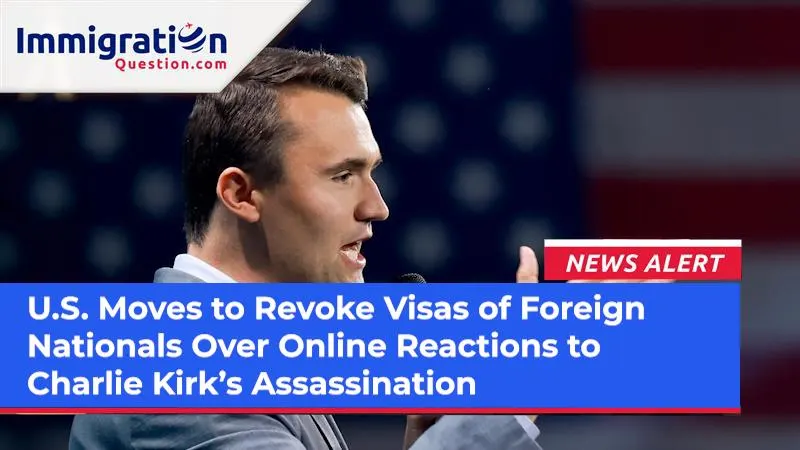
The U.S. State Department has revoked the visas of several foreign nationals who publicly celebrated the assassination of conservative activist Charlie Kirk. Officials say the move underscores a broader federal effort to scrutinize visa holders who promote or justify violence against Americans, reflecting heightened immigration enforcement under the Trump administration.
Visa Revocations Follow Online Celebrations of Political Violence
The U.S. government has announced the revocation of multiple visas belonging to foreign nationals who praised or justified the killing of conservative activist Charlie Kirk, a Trump ally who was fatally shot during a public event in Utah. The State Department said such expressions have no place for individuals hosted by the United States.
Officials confirmed that visa reviews are underway for other foreign nationals who made inflammatory remarks online following Kirk’s assassination. The department emphasized that holding a U.S. visa is a privilege that may be withdrawn when an individual engages in conduct that threatens public safety or glorifies acts of violence.
Nationalities Identified in State Department Review
In its statement, the department cited several examples of individuals whose visas were revoked. Among them were nationals of Argentina, South Africa, Mexico, Brazil, Germany, and Paraguay, each accused of using social media to celebrate Kirk’s death or justify his killing.
An Argentine national reportedly called Kirk’s death deserved, while a Brazilian national wrote that he died too late. Similar remarks were traced to a South African user who mocked Americans mourning Kirk’s death and to a German national who said, when fascists die, democrats don’t complain. Officials said such cases are being handled under existing immigration statutes that permit visa cancellation on grounds of public safety and national interest.
Policy Shift Toward Online Conduct and Immigration Status
The State Department’s actions are part of a wider policy effort to address violent or extremist online speech by noncitizens. Under current immigration law, the U.S. retains authority to deny or revoke visas for those who endorse, incite, or glorify violence. The department indicated that further reviews are ongoing to identify other offenders.
A spokesperson said the decision reflects a zero-tolerance approach to foreign nationals who wish harm on Americans or condone politically motivated violence. Immigration commentators note that this measure is an expansion of the means in which online discourse can converge with immigration enforcement, primarily when online discourse is used as threats or calling for deadly actions.
Political and Legal Implications
The visa revocation follows the killing of Turning Point USA co-founder Charlie Kirk, who was shot at a university gathering in Utah last month. Tyler Robinson, 22, has been charged with several felonies, including aggravated murder and witness tampering. Federal prosecutors have announced plans to seek the death penalty.
The policy’s singling out of foreign nationals who expressed their views about the killing has raised eyebrows among legal commentators, some of whom question whether internet speech as such is a sufficient criterion for visa eligibility. Some justify the policy as being needed to prevent the U.S. from becoming a magnet for individuals sympathetic to political violence.
Looking Ahead
The State Department stated that additional visa actions are under review as agencies continue to monitor digital spaces for similar expressions of violence. Officials suggest that more revocations could follow if foreign nationals are found to be celebrating or promoting acts of political extremism.
Immigration analysts believe the policy may broaden scrutiny of foreign speech that intersects with U.S. domestic security concerns — a move likely to spark future legal challenges.
For continued coverage of U.S. immigration enforcement and policy developments, visit ImmigrationQuestion.com. Get answers to your immigration questions from licensed immigration attorneys. For attorneys, use our innovative 3-in-1 case management software to grow your practice. Download our free app on Google Play and the Apple App Store.
Resource:
- https://www.foxnews.com/politics/state-department-revokes-six-visas-over-offensive-charlie-kirk-assassination-comments
- https://www.reuters.com/world/us/us-revokes-visas-six-foreigners-over-comments-made-about-charlie-kirks-death-2025-10-14/
- https://edition.cnn.com/2025/10/14/politics/state-department-revoke-visas-charlie-kirk-murder
- https://www.cbsnews.com/news/trump-administration-revokes-visas-charlie-kirk/ https://www.theguardian.com/us-news/2025/oct/14/us-foreign-visas-charlie-kirk-social-media
- https://www.washingtonpost.com/politics/2025/10/15/us-visas-charlie-kirk-state-department/
**ImmigrationQuestion.com is a third-party platform that serves as a meeting ground for licensed immigration attorneys and people with immigration questions. It is not a law firm. It is not affiliated with or endorsed by USCIS or AILA. Attorneys on this platform are independent and have the discretion to offer a free consultation and/or set their fees under the law.