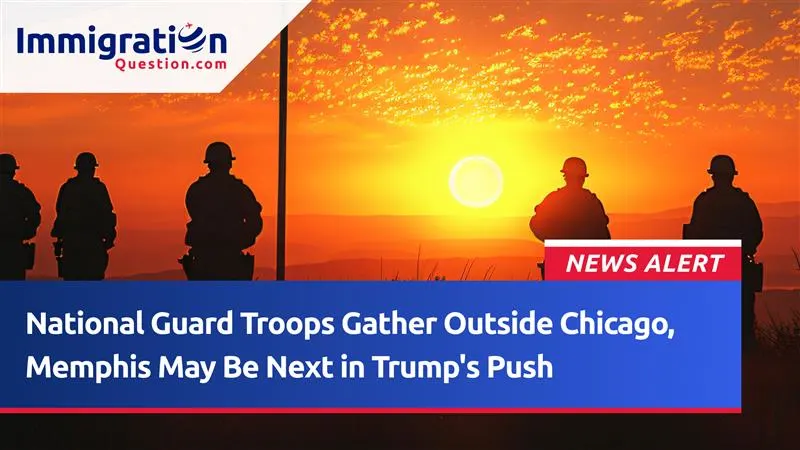
National Guard troops from Texas are stationed outside Chicago. They could deploy to Memphis by the end of the week as the Trump administration intensifies its domestic security campaign. The move, part of a broader strategy to target urban centers, has drawn legal challenges and sharp opposition from local officials in multiple states.
Troops Positioned Outside Chicago Amid Legal Disputes
National Guard units from Texas settled this week at a U.S. Army Reserve center in Elwood, Illinois, roughly 55 miles southwest of Chicago. The deployment, authorized by President Donald Trump, comes despite pending litigation and growing opposition from Illinois and city leaders who claim the action undermines state authority and fuels unnecessary tension.
The troops’ specific assignment remains unclear, but federal sources confirmed they are to “support law enforcement and immigration enforcement activities” under the president’s expanded internal security policy.
Trump’s Expanding Urban Security Operations
The deployment is part of Trump’s broader effort to station National Guard and federal law enforcement across U.S. cities deemed “noncompliant” with federal immigration directives.
Similar actions have taken place in Los Angeles, Portland, and Chicago—cities with Democratic leadership that have openly opposed the administration’s enforcement priorities.
In recent weeks, Trump has characterized Chicago as “a city in crisis,” citing ongoing immigration protests and a perceived breakdown in law enforcement.
Yet crime data shows significant reductions in homicides and violent crime this year, raising questions about the necessity and legality of a military-style response.
Memphis Next in Line for Federal Deployment
In Memphis, Tennessee, police officials confirmed that federal and local commanders have begun advance coordination for a potential arrival of the National Guard.
The state’s governor, Bill Lee, said the troops would operate under federal authority but be deputized to assist U.S. Marshals in “supportive security functions.”
Local leaders, however, remain uncertain about the scope of those operations. Civil rights groups have raised concerns that the deployments could blur lines between federal and local law enforcement, potentially escalating public demonstrations and deepening mistrust in immigrant-heavy neighborhoods.
States Push Back Against Federal Overreach
Illinois Governor JB Pritzker and Chicago Mayor Brandon Johnson have both moved to block federal immigration agents from using city property as staging areas.
They have also sought a court injunction to halt Trump’s deployment, arguing that it constitutes an unlawful expansion of presidential power under the Posse Comitatus Act.
The act, which limits the military’s role in civilian law enforcement, has been a key focus of ongoing court arguments. Trump has hinted that he could invoke the Insurrection Act, a rare executive authority allowing active-duty military operations within U.S. borders if states are deemed unable to maintain order.
A hearing on Illinois’ lawsuit is scheduled for Thursday in federal court. Oregon, which previously challenged similar deployments to Portland, is monitoring developments closely following a recent ruling that temporarily blocked further Guard deployments there.
Growing National Tension Over Immigration Enforcement
The renewed mobilization comes amid a month-long immigration crackdown that has targeted urban protest zones and immigrant communities. Border Patrol and ICE agents have increased their visibility in major cities, drawing both public demonstrations and local pushback.
Trump’s administration argues the measures are essential to restore federal control and deter what it calls “lawless sanctuary policies.” Critics counter that the actions are politically motivated, designed to showcase toughness ahead of ongoing policy reviews in Congress.
Look Ahead
As legal battles intensify and troop movements expand, the coming days may determine whether the courts curb or sustain Trump’s latest domestic deployment strategy. The outcome could shape the limits of federal power in state-controlled jurisdictions and set new precedents for future immigration enforcement actions.
For additional immigration news and analysis, check ImmigrationQuestion.com. Get answers to your immigration questions from licensed immigration attorneys. For attorneys, use our innovative 2-in-1 case management software to grow your practice. Download our free app on Google Play and the Apple App Store.
Resources:
**ImmigrationQuestion.com is a third-party platform that serves as a meeting ground for licensed immigration attorneys and people with immigration questions. It is not a law firm. It is not affiliated with or endorsed by USCIS or AILA. Attorneys on this platform are independent and have the discretion to offer a free consultation and/or set their fees under the law.