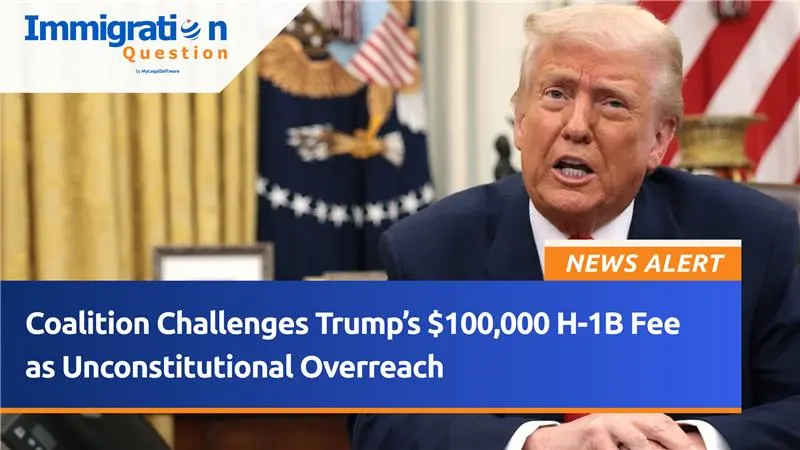
A sweeping coalition of unions, universities, and employers has filed a federal lawsuit challenging President Trump’s plan to impose a $100,000 fee on H-1B visa petitions. The groups argue the order violates both immigration law and the U.S. Constitution, calling it a dangerous overreach that threatens America’s innovation-driven economy.
Broad Legal Coalition Pushes Back Against Trump’s H-1B Fee
The case, lodged in San Francisco, marks the first formal legal challenge to one of the administration’s most controversial immigration policies to date.
The lawsuit comes just two weeks after the president issued a proclamation mandating the six-figure payment as a condition for new H-1B visa holders to enter the United States. Plaintiffs include the United Auto Workers (UAW), the American Association of University Professors (AAUP), a nurse staffing agency, and several religious groups.
Lawsuit Argues Violation of Federal and Constitutional Law
At the center of the lawsuit is a claim that Trump’s order violates both statutory and constitutional limits on executive power. According to the plaintiffs, the president cannot rewrite that framework through executive proclamation.
Calling the $100,000 charge an unlawful tax imposed without legislative authority, the suit asserts that “The Constitution assigns taxation and revenue powers to Congress, not the White House”.
The plaintiffs warn that allowing such unilateral actions would set a dangerous precedent, enabling future administrations to bypass Congress on matters of immigration and employment.
Administration Defends Fee as Necessary Reform
Spokeswoman Abigail Jackson said the policy targets employers who “abuse the system” and drive down wages by over-relying on lower-paid foreign labor. President Trump argued that the H-1B program, as currently operated, has eroded opportunities for U.S. citizens and threatens national security by discouraging domestic participation in science and technology careers.
Currently, employers pay between $2,000 and $5,000 in filing and processing fees for each H-1B visa application. The new $100,000 charge – representing a twentyfold increase – would apply to new visa holders and not to those already in the United States or who submitted applications before September 21.
Critics Warn of Economic and Global Consequences
Business leaders, educators, and industry groups warn the fee could devastate sectors already facing critical labor shortages.
The program provides 65,000 visas annually, with an additional 20,000 reserved for applicants with advanced degrees. Last year, India accounted for 71% of approved H-1B visas, while China followed with 11.7%, according to U.S. government data.
Opponents argue that the disproportionate fee would discourage employers from participating, lead companies to outsource employment, and prevent international talent from coming to the United States.
Broader Implications for Executive Power
The case is larger than a battle over work visas—it is a test of executive power and separation of powers between the legislative and executive branches. If the plaintiffs succeed, it could constrain future administrations from imposing immigration-related financial burdens without congressional approval.
The suit could end up in the Supreme Court, legal commentators note, due to its constitutional nature and the extent to which it could reshape the power equation in immigration policy. For now, U.S. employers and foreign workers alike await clarity on whether the six-figure visa fee will move forward or be blocked by the courts.
A Look Ahead
The federal court’s handling of the case will determine not only the fate of the $100,000 H-1B fee but also set a precedent for future immigration reforms carried out by executive order. The ruling would affect thousands of employees, employers, and families depending on high-skill visa programs across the country.
ImmigrationQuestion.com will continue to monitor developments as the case proceeds and analyze its implications on employment-based immigration, national economic competitiveness, and the scope of presidential authority.
For additional immigration news and analysis, check ImmigrationQuestion.com. Get answers to your immigration questions from licensed immigration attorneys. For attorneys, use our innovative 2-in-1 case management software to grow your practice. Download our free app on Google Play and the Apple App Store.
Resources:
**ImmigrationQuestion.com is a third-party platform that serves as a meeting ground for licensed immigration attorneys and people with immigration questions. It is not a law firm. It is not affiliated with or endorsed by USCIS or AILA. Attorneys on this platform are independent and have the discretion to offer a free consultation and/or set their fees under the law.