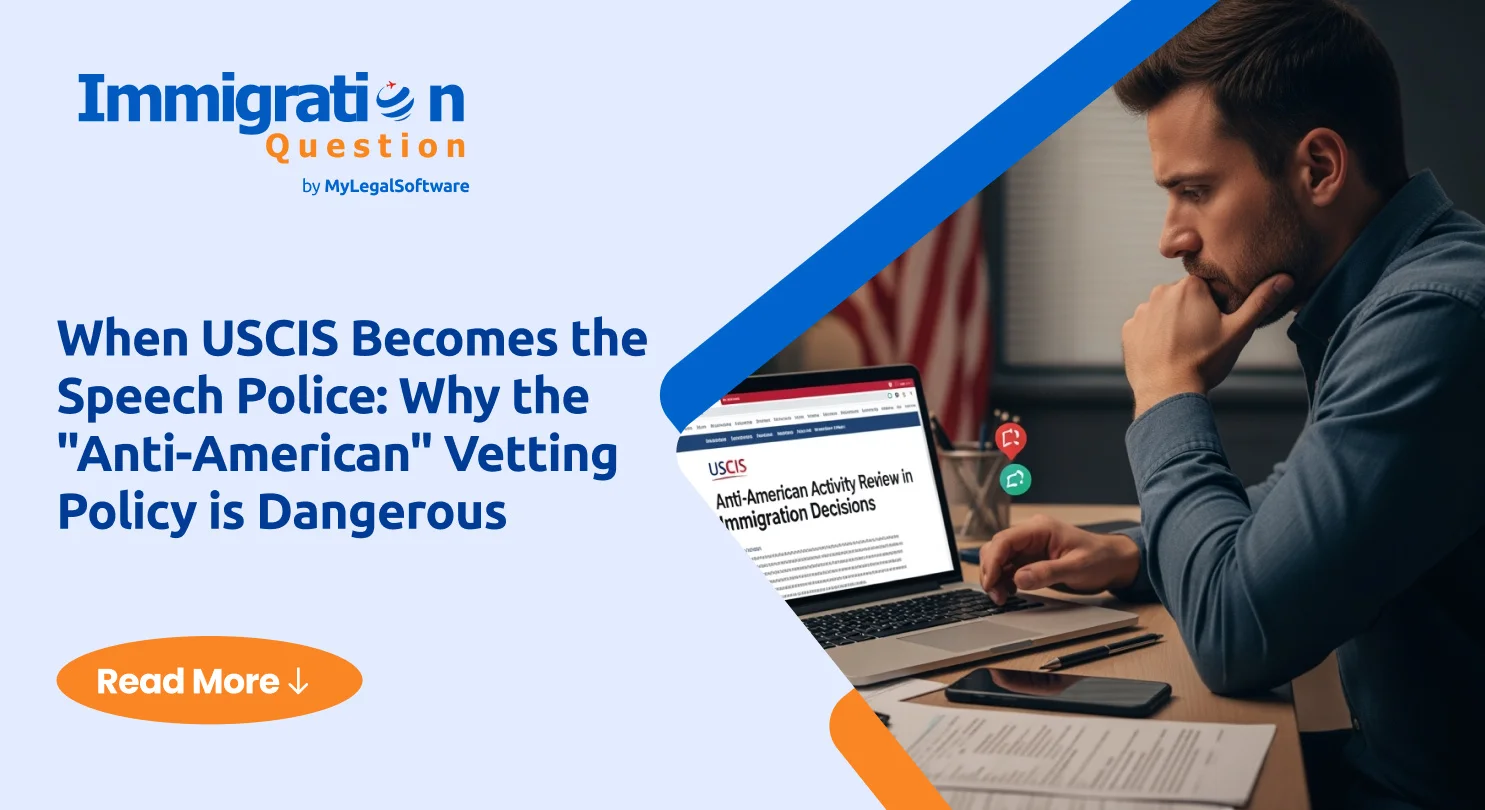
The Trump administration recently announced that U.S. Citizenship and Immigration Services (USCIS) will now consider “anti-American” views expressed on social media when granting immigration benefit requests. Such views will be used in deciding whether immigrants can live, work, or become citizens in the United States.
“America’s benefits should not be given to those who despise the country and promote anti-American ideologies,” a USCIS spokesperson declared. To that end, officers are now directed to review online profiles for any indications of hostility toward the citizens, culture, government, institutions, or founding principles of the United States.
At first glance, this seems like a commonsense measure—why should the U.S. extend privileges to people who hate it? But underneath the promise of security, the government is stretching its power in a way that confuses protecting the country with controlling free speech.
A Vague Standard
The announcement hinges on the concept of “anti-American activity.” But what exactly does that mean? The Immigration and Nationality Act (INA), which dates back to 1952, focused on communism when it used the term. Today, USCIS provides no definite scope, meaning it could cover everything from violent extremism to an immigrant criticizing U.S. foreign policy, or even mocking American pop culture online.
In practice, this vagueness gives USCIS officers extraordinary discretion. One officer might see a Facebook post criticizing racism in America as legitimate free speech. Another might interpret it as hostility toward U.S. institutions. The policy turns subjective interpretation into grounds for denial.
Free Speech on the Chopping Block
This policy also undermines core American values. Free expression is supposed to be a cornerstone of U.S. democracy. Yet by making immigration benefits contingent on an applicant’s online speech, USCIS is saying: citizens may criticize the government freely, but immigrants must hold their tongues.
Those applying for visas or green cards will feel pressure to self-censor, avoiding any comment that could be misread as “anti-American.” This policy sends a message that political dissent is suspect, especially if voiced by noncitizens.
Discretion Without Accountability
USCIS has long used discretion in adjudicating benefits, but this announcement amplifies that power. Another recent official directive on “good moral character,” for example, tells officers to conduct a “holistic” assessment of an applicant’s life, considering not only wrongdoing but also community ties, caregiving, and education.
This directive, paired with the anti-American speech review, means officers can deny applications for failing to meet subjective standards of patriotism or conformity.
A Pattern of Restricting Legal Immigration
This move fits into a larger pattern by the Trump administration: while making headlines with border crackdowns and deportations, it has quietly restricted legal immigration as well. Refugee admissions have been slashed, visa pathways narrowed, and vetting procedures made increasingly difficult.
The expansion of social media surveillance and speech-based vetting may be interpreted as another means to discourage or deny applications. It is less about national security and more about shrinking the number of people who can successfully integrate into the U.S. system.
Security Without Silencing
There is no dispute that the U.S. must guard against genuine threats. Immigration law contains robust grounds for exclusion, from terrorism to espionage to criminal activity. But the difference between screening for dangerous conduct and screening for disfavored opinions is profound. The first protects public safety. The second polices thought.
If this policy were truly about security, it would focus on concrete actions and networks, not on an ill-defined category of “anti-American activity.”
The Slippery Slope
According to the Trump administration, immigration is a privilege, not a right. Yet this approach leaves us wondering whether free speech is heading down the same path.
Today, it’s “anti-American activity.” Tomorrow, could it be support for unpopular political causes? Criticism of U.S. wars abroad? Advocacy for systemic change? Once discretion becomes this subjective, almost any expression can be twisted into a reason for denial.
Immigrants are applying for the opportunity to live, work, and contribute to a society that claims to value freedom. The U.S. weakens that claim when it makes immigration status contingent on enforced silence.
Stay in the Know with ImmigrationQuestion.com
As new immigration policies are being implemented, immigrants and their families need to stay informed about how these changes might affect them.
At ImmigrationQuestion.com, you’ll find answers, updates, and guidance on the latest shifts in U.S. immigration law. If you want to understand what these policies mean, visit ImmigrationQuestion.com today.