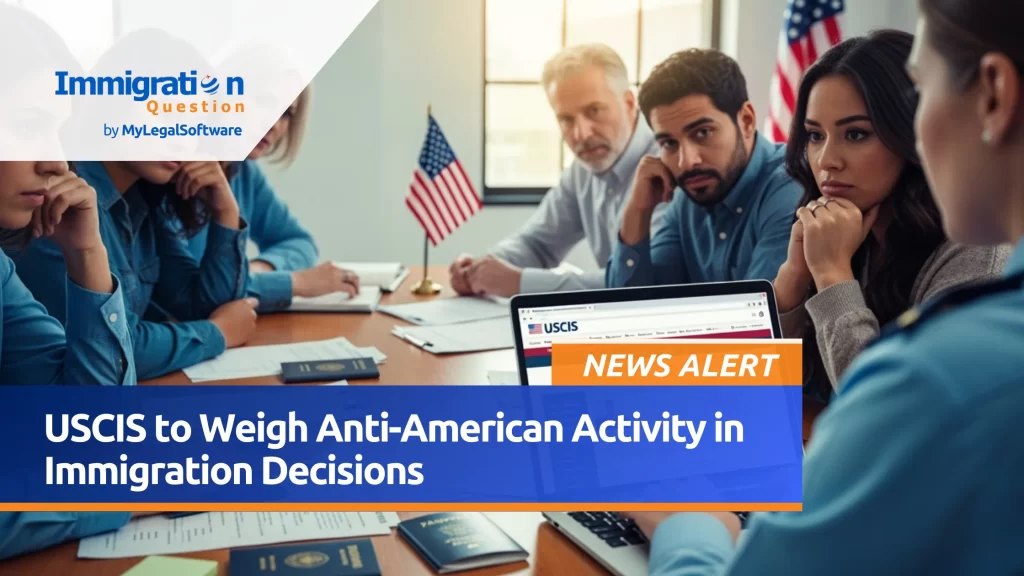
U.S. Citizenship and Immigration Services (USCIS) released new policy guidance requiring officers to consider applicants’ affiliation with anti-American activity and extremist organizations in processing requests for benefits. The new regulations expand social media vetting, impose compliance with immigration laws, and again emphasize that immigration benefits are a privilege and not an entitlement.
New Policy Guidance on Immigration Benefits
USCIS published updates to its Policy Manual that broadly expand the criteria officers must consider when adjudicating immigration benefit applications. The policy covers previous requests for parole, participation in terrorist or anti-American organizations, and any recorded activity related to antisemitism. Officials explained that the policy aims to avoid benefits being granted to individuals whose ideologies are harmful to U.S. security or values.
This revision of policy is one facet of an ongoing push to make immigration determinations more in line with national interests. In making consideration of anti-American activity and extremism a formal aspect, USCIS is seeking to close loopholes that critics have accused of enabling those with potentially dangerous ideologies to abuse the system.
Anti-American Activity as a Decisive Factor
Anti-American activity will carry significant weight in discretionary decisions in the new regime. USCIS elaborated that individuals who openly promote hostility to the United States, or those promoting antisemitic terrorist organizations, will have serious hurdles to overcome. Immigration benefits, officials further stated, are intended to accrue to individuals who make positive contributions to American society.
The new policy insists that immigration is a privilege subject to conditions, not a right. Applicants may meet the minimum standards, but discretionary review allows benefits denial when broader issues of ideology, allegiance, or conduct raises questions. This shift underscores the importance of ensuring immigration channels align with U.S. values and security objectives.
Enhanced Social Media Vetting
USCIS has also extended social media screening to search for anti-American statements, extremist language, or activity showing association with enemy ideologies. Officers will now include social media findings in the overall evaluation, giving online activity an official rating in decision-making.
This expansion is a growing reliance on digital trails as indicators of intention and personality. Supporters have justified it as capable of revealing risks not made clear by standard background checks. Others caution that it raises free speech and privacy concerns, but USCIS insists that the measure is needed to detect danger before granting benefits.
Enhancing Compliance with Immigration Law
Besides the focus on anti-American conduct, USCIS is reiterating the idea that adherence to immigration law remains more critical than discretionary action. Individuals who have violated immigration regulations, committed fraud, or misrepresented facts will face greater difficulty achieving favorable outcomes.
In addition, the directive describes how discretion shall be applied in sensitive categories such as EB-5 investor petitions. Fraud, misrepresentation, and threats to national interest cases shall be scrutinized further to ensure that economic investment programs are not exploited by individuals who want to avoid broader security issues.
What’s Next? Binding as of – Effective Immediately
The new regulations, enacted in Volume 1 of the USCIS Policy Manual, are effective immediately and will apply to all currently pending and future cases. USCIS noted that this guidance is a replacement for previous instructions and provides officers with a clear and binding framework on how to balance anti-American activity and other discretionary considerations.
By applying these changes immediately, the agency demonstrated its commitment to resisting mounting threats via the immigration process. The change represents a significant policy shift, making explicit what was once implicit: ideological alignment to U.S. values is now a central consideration in benefit adjudication.
For timely updates and analysis on immigration enforcement and related immigration issues, visit ImmigrationQuestion.com. Get answers to your immigration questions from licensed immigration attorneys. For attorneys, use our innovative 2-in-1 case management software to grow your practice. Download our free app on Google Play and the Apple App Store.
Resources:
- https://www.uscis.gov/newsroom/news-releases/uscis-to-consider-anti-americanism-in-immigrant-benefit-requests
- https://www.cnn.com/2025/08/19/us/us-immigrants-screening-anti-american-hnk
- https://www.cbsnews.com/news/us-anti-american-views-immigration-benefits/
- https://blog.immigrationquestion.com/news/new-policy-may-require-social-media-handles-for-immigration-applicants/
**ImmigrationQuestion.com is a third-party platform that serves as a meeting ground for licensed immigration attorneys and people with immigration questions. It is not a law firm. It is not affiliated with or endorsed by USCIS or AILA. Attorneys on this platform are independent and have the discretion to offer a free consultation and/or set their fees under the law.