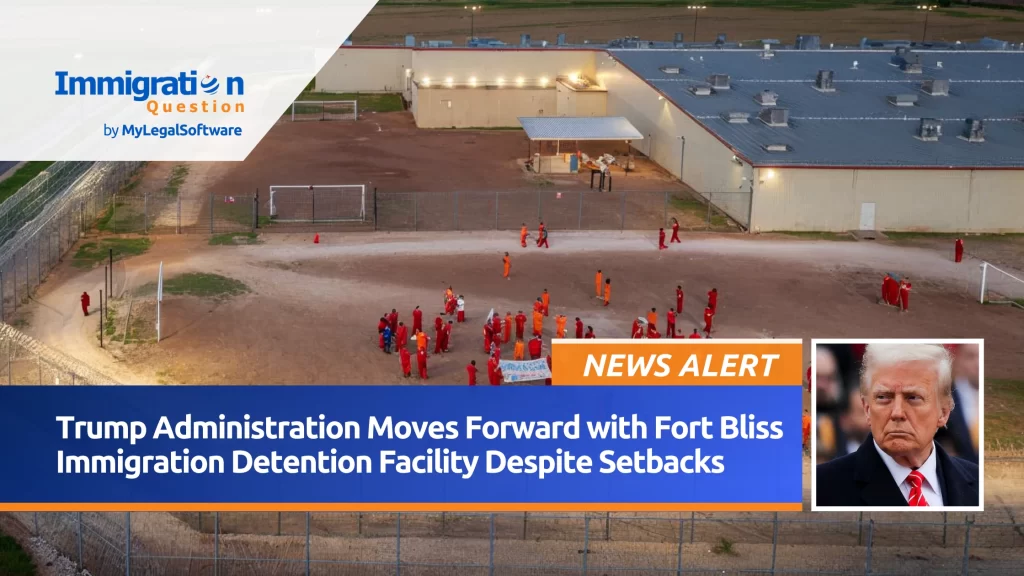
Later this week, the Trump administration is expected to open a large immigration detention facility at Fort Bliss, Texas, which is set to become the largest of its kind in the country once fully operational. Initially planned to address overcrowding in Immigration and Customs Enforcement (ICE) detention centers, the project has faced numerous hurdles, including investigations into the contracting process, canceled agreements, and even a fatal workplace accident.
A Key Part of ICE’s Expansion Efforts
The Fort Bliss facility will launch with space for approximately 1,000 detainees, marking a significant step in ICE’s goal to more than double detention capacity nationwide. This expansion aligns with the administration’s aggressive approach to increasing immigrant arrests, with ICE already holding a record 60,000 detainees.
The new site replaces earlier, less successful plans, such as the proposed large-scale use of the U.S. naval base at Guantánamo Bay. However, the rapid push for expansion has brought to light operational and logistical challenges that come with scaling up detention space quickly.
Why Fort Bliss Was Chosen
Located on a vast Army base in the Texas desert, Fort Bliss offers the land needed for large-scale temporary facilities. ICE, along with the Department of Homeland Security (DHS), opted for soft-sided tent structures rather than traditional brick-and-mortar buildings. These temporary facilities can be established more quickly, allowing ICE to respond to immediate capacity shortages.
Private prison companies such as CoreCivic and GEO Group have noted the growing role of such facilities, which can be operational in a fraction of the time required to construct permanent structures. However, they are also more expensive in the long term due to higher operational costs, including utilities, food, and security needs.
Financial and Administrative Hurdles
Although funding has been earmarked through the Republican-backed spending plan, much of the budget has yet to be released. In the meantime, DHS Secretary Kristi Noem has implemented new oversight measures requiring personal approval for ICE expenditures over $100,000, a step aimed at preventing waste but which could also slow construction timelines.
The Fort Bliss project itself has undergone multiple rounds of bidding. Two contracts were canceled amid scrutiny over the procurement process, with one citing a presidential executive order on spending transparency. Eventually, the construction contract was awarded under a Navy program for small businesses, bypassing direct ICE oversight.
Contracting Controversies and Legal Challenges
The lead contractor, Acquisition Logistics Company—a small Virginia-based firm—has faced questions over its limited public presence and past contract experience. One unsuccessful bidder, Gemini Tech Services, has filed a sealed federal court complaint seeking to halt construction, adding further uncertainty to the project’s timeline.
Safety Concerns and Tragic Incident
In July, the project suffered a setback when Hector Gonzalez, a worker employed by a subcontractor, died in a workplace accident. The incident is now under investigation by both the Occupational Safety and Health Administration (OSHA) and the U.S. Army Criminal Investigation Division. In response, a new safety manager position has been posted to oversee accident prevention on-site.
Broader Implications of Tent Facilities
While tent facilities can be built quickly, they pose long-term financial and operational concerns. They require more security staff to prevent escapes and often involve additional costs to provide basic amenities in remote areas. Traditionally, such facilities have been used for short-term holding. However, under current plans, detainees could remain for months, increasing the strain on resources.
Looking Ahead
The opening of Fort Bliss represents both an immediate solution to ICE’s overcrowding and a case study in the complexities of rapidly expanding detention capacity. While the facility’s launch is imminent, ongoing litigation, safety concerns, and financial oversight requirements could influence how quickly it scales up.
If the project proceeds as planned, Fort Bliss could become central to the administration’s enforcement strategy. However, its long-term sustainability—and the precedent it sets for soft-sided detention facilities—remains under close watch by policymakers, industry stakeholders, and immigrant rights advocates.
For timely updates and analysis on immigration enforcement and related immigration issues, visit ImmigrationQuestion.com. Get answers to your immigration questions from licensed immigration attorneys. For attorneys, use our innovative 2-in-1 case management software to grow your practice. Download our free app on Google Play and the Apple App Store.
Resources:
- https://www.nbcnews.com/politics/immigration/trump-administration-hits-hurdles-builds-key-immigrant-detention-facil-rcna224608
- https://www.yahoo.com/news/articles/trump-administration-hits-hurdles-builds-090000139.html
**ImmigrationQuestion.com is a third-party platform that serves as a meeting ground for licensed immigration attorneys and people with immigration questions. It is not a law firm. It is not affiliated with or endorsed by USCIS or AILA. Attorneys on this platform are independent and have the discretion to offer a free consultation and/or set their fees under the law.