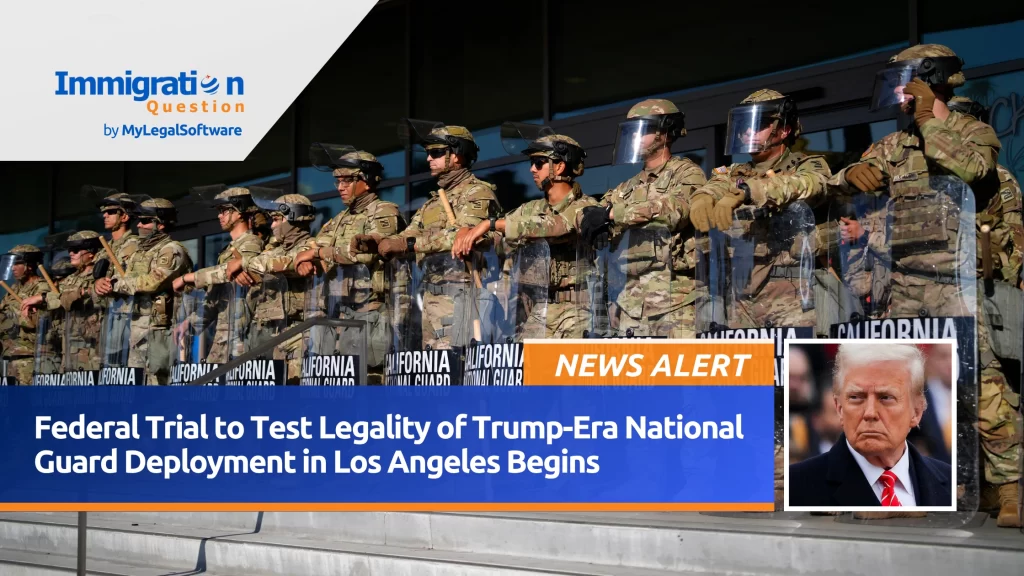
A federal court in San Francisco is set to examine whether the Trump administration acted within the law when it deployed California National Guard soldiers and U.S. Marines to Los Angeles in the wake of immigration-related protests earlier this summer. The move, which federalized state troops, was made despite opposition from California Governor Gavin Newsom and city leaders.
The deployment followed protests on June 7, sparked by multiple arrests carried out by Immigration and Customs Enforcement (ICE) officers at various locations across the city. Federal authorities maintained that the measure was necessary to safeguard federal buildings and personnel amid rising tensions. However, state officials view the action as an overreach of federal authority.
California’s Legal Challenge
The State of California is asking U.S. District Judge Charles Breyer to restore control of the remaining National Guard members to the state. The request also seeks to bar the federal government from using military troops in California for law enforcement duties or to assist federal agents in civilian law enforcement activities.
The state’s argument rests heavily on the 1878 Posse Comitatus Act, which prohibits the use of the U.S. military as a domestic police force. Officials believe that the administration’s actions not only violated this statute but also infringed upon the Tenth Amendment, which outlines the division of powers between state and federal governments.
Judge Breyer previously sided with California in an early ruling, finding that the federal government had exceeded its authority. However, the Trump administration appealed the decision, and an appellate court granted a temporary stay, allowing federal control of the California National Guard to continue while the lawsuit progresses.
Deployment and Activities of Federalized Troops
The Department of Defense initially ordered around 4,000 California National Guard soldiers and 700 Marines into service. While most have since departed, approximately 250 Guard members remain stationed at the Joint Forces Training Base in Los Alamitos.
During their deployment, National Guard troops assisted federal immigration officers in conducting raids across Los Angeles and at marijuana cultivation sites in Ventura County. Marines were primarily assigned to protect a downtown Los Angeles federal building, which includes a detention facility at the center of the protests.
The federal government has justified the deployment by pointing to instances where local law enforcement allegedly delayed responding to protest activity, particularly outside federal buildings. Officials argued that the presence of the troops was essential in maintaining order and safeguarding federal property.
Trump Administration’s Defense
Lawyers for the administration maintain that the president acted under Section 12406 of Title 10 of the U.S. Code, which permits federalizing the National Guard in situations involving invasions, rebellions, or significant threats to the enforcement of U.S. laws. They claim that local and state resources were insufficient to address the problem.
However, Judge Breyer has already expressed skepticism, noting that the protests in Los Angeles do not meet the legal threshold for a rebellion.
Looking Ahead
The case has the potential to set a significant precedent regarding the limits of presidential authority to deploy the National Guard within states. A ruling in favor of California could strengthen state autonomy in matters of military control and limit the scope of federal intervention during domestic unrest. Conversely, a win for the Trump administration could broaden executive powers in mobilizing state forces for federal purposes.
The trial’s outcome is likely to influence not only future deployments in California but also the balance of power between state and federal governments across the United States.
For timely updates and analysis on immigration enforcement and related immigration issues, visit ImmigrationQuestion.com. Get answers to your immigration questions from licensed immigration attorneys. For attorneys, use our innovative 2-in-1 case management software to grow your practice. Download our free app on Google Play and the Apple App Store.
Resources:
- https://apnews.com/article/california-trump-national-guard-lawsuit-924491849641549828c4f52a41d54e6b
- https://www.usnews.com/news/us/articles/2025-08-11/trial-to-start-on-whether-deployment-of-national-guard-to-los-angeles-violated-federal-law
- https://blog.immigrationquestion.com/news/national-guard-deployed-to-los-angeles-amid-violent-protests-over-immigration-raids-and-federal-crackdown/
- https://blog.immigrationquestion.com/news/trump-expands-troop-deployment-as-la-immigration-demonstrations-continue/
- https://blog.immigrationquestion.com/news/appeals-court-temporarily-allows-trump-to-keep-national-guard-in-los-angeles-amid-protests/
**ImmigrationQuestion.com is a third-party platform that serves as a meeting ground for licensed immigration attorneys and people with immigration questions. It is not a law firm. It is not affiliated with or endorsed by USCIS or AILA. Attorneys on this platform are independent and have the discretion to offer a free consultation and/or set their fees under the law.