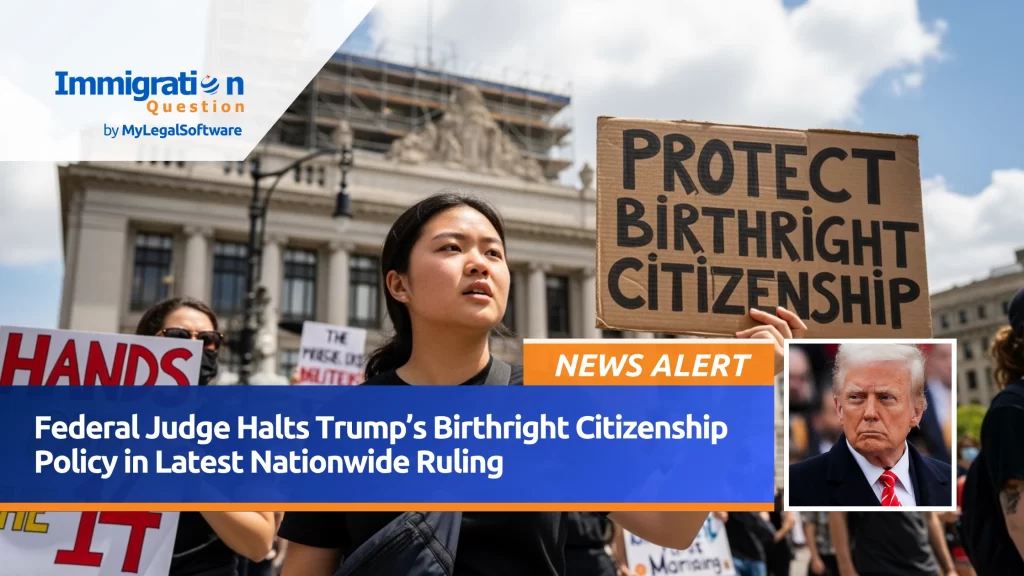
A Maryland federal judge has blocked the Trump administration’s birthright citizenship order from taking effect nationwide. This marks the fourth such ruling since a recent U.S. Supreme Court decision limited nationwide injunction. The court certified a class of impacted children, allowing broader relief under the Constitution’s 14th Amendment.
Court Blocks Enforcement of Citizenship Order Nationwide
A federal judge in Maryland issued a preliminary injunction on Thursday halting the Trump administration’s attempt to restrict birthright citizenship for children born in the U.S., to undocumented immigrants or temporary visa holders. The order marks the fourth nationwide block of the policy since the U.S. Supreme Court’s June ruling curbed lower courts’ power to issue broad injunctions.
U.S. District Judge Deborah Boardman’s decision directly challenges the January executive order issued by President Donald Trump, which sought to deny automatic citizenship to certain U.S.-born children. Her ruling allows relief to proceed by certifying a class of affected individuals, sidestepping the Supreme Court’s limits while preserving the order’s nationwide effect.
Court Cites 14th Amendment, Certifies Affected Class
Trump’s January 2025 order targeted children born to individuals in the country without legal status or on temporary visas, sparking immediate legal challenges. Plaintiffs argued the directive violated the 14th Amendment, which guarantees U.S. citizenship to all individuals born on American soil and subject to its jurisdiction.
Judge Boardman had previously blocked the order in February. However, her ruling was affected by the Supreme Court’s June decision, which limited the use of nationwide injunctions except in narrow circumstances. The high court signaled, however, that courts could still issue class-wide relief or other orders with nationwide consequences in specific contexts.
On Thursday, Judge Boardman certified a class including all children born or expected to be born after February 19, 2025, to parents potentially affected by the order. She ruled that the plaintiffs were “extremely likely” to prove the order unconstitutional, and face irreparable harm if it were implemented.
Part of a Broader Pattern of Court Pushback
Judge Boardman’s decision follows similar rulings from two other district courts and a federal appellate panel, each rejecting the administration’s interpretation of the 14th Amendment. Together, the four rulings have left the order unenforceable for now, dealing a significant blow to one of the administration’s signature immigration initiatives.
The White House has not publicly commented on the ruling. The Department of Justice is expected to appeal, but no formal announcement has been made.
Legal Focus Shifted to Constitutional Guarantees
Legal contention revolves around the Citizenship Clause of the 14th Amendment. The clause has been the basis of automatic citizenship in America for decades. Legal analysts warn that any attempt to alter this doctrine by executive order, as opposed to constitutional Amendment or statute, raises grave constitutional concerns.
In her opinion, Judge Boardman stated that the administration’s order “directly contradicts the text and history” of the 14th Amendment. She pointed out that no previous administration had tried to reinterpret birthright citizenship in this way.
Look Ahead – Impacts on Immigration Policy Before 2026
The ruling comes when immigration has been a seminal issue for the current Trump administration, especially with the 2026 midterm elections approaching. The birthright order has been one in a series of recent policies challenged by the courts. It reflects the conflict between executive power and constitutional rights.
Despite the Supreme Court’s recent limits on broad injunctions, Thursday’s decision shows that federal courts still have legal tools to protect large groups when fundamental rights are at risk. Legal advocates and civil rights groups have welcomed the ruling, while continuing to track similar challenges underway in other jurisdictions.
For timely updates and analysis on immigration enforcement and related immigration issues, visit ImmigrationQuestion.com. Get answers to your immigration questions from licensed immigration attorneys. For attorneys, use our innovative 2-in-1 case management software to grow your practice. Download our free app on Google Play and the Apple App Store.
Resources:
- https://apnews.com/article/trump-birthright-citizenship-judge-blocked-order-1b126f594c6a2d7dda3888d82cefd4eb
- https://blog.immigrationquestion.com/news/birthright-citizenship-battle-intensifies-as-court-blocks-trump-policy-again/
- https://www.cbsnews.com/news/judge-block-trump-birthright-citizenship-supreme-court/
- https://blog.immigrationquestion.com/news/federal-judge-moves-to-block-trumps-birthright-citizenship-order-nationwide/
- https://blog.immigrationquestion.com/news/trump-administration-pushes-for-partial-restrictions-on-birthright-citizenship-at-supreme-court/
- https://blog.immigrationquestion.com/news/nationwide-block-on-trumps-birthright-citizenship-order-holds-firm/
- https://blog.immigrationquestion.com/news/fourth-federal-judge-halts-trumps-birthright-citizenship-order-amid-legal-challenges/
**ImmigrationQuestion.com is a third-party platform that serves as a meeting ground for licensed immigration attorneys and people with immigration questions. It is not a law firm. It is not affiliated with or endorsed by USCIS or AILA. Attorneys on this platform are independent and have the discretion to offer a free consultation and/or set their fees under the law.