
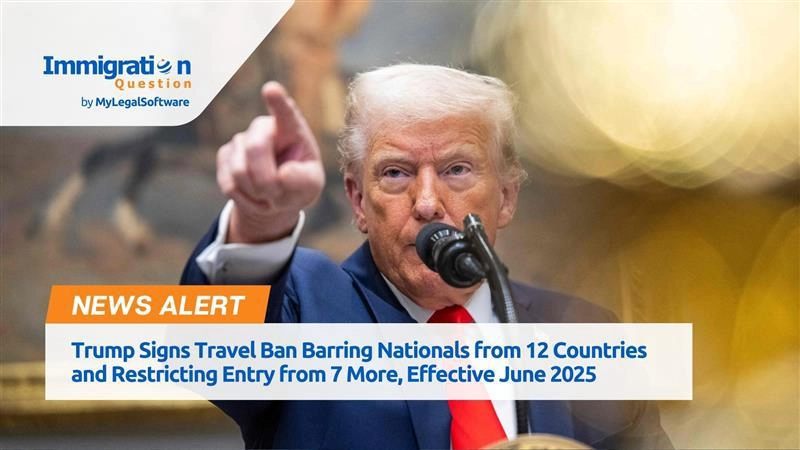
President Donald Trump signed a sweeping order Wednesday that closes the door on visitors and immigrants from 12 countries completely and imposes partial entry bans on citizens of seven other nations. The order, which was signed citing national security concerns, takes effect at 12:01 a.m. on Monday, June 9, 2025.
Wide-Ranging Ban and Partial Restrictions Announced
A complete ban is in place for Afghanistan, Myanmar, Chad, the Republic of Congo, Equatorial Guinea, Eritrea, Haiti, Iran, Libya, Somalia, Sudan, and Yemen. The nationals of these countries are not eligible to travel to the United States as immigrant visa holders or temporary visa holders, such as tourists or students, with certain exceptions.
Partial bans are imposed on the citizens of Burundi, Cuba, Laos, Sierra Leone, Togo, Turkmenistan, and Venezuela. They face restrictions on permanent immigration visas and some temporary visa categories but are not prevented from applying for specific short-term visas.
National Security and Vetting Concerns Drive the Ban
The Trump White House justified the travel bans as necessary to rescue Americans from foreign terrorists and security threats. The ban targets nations with inadequate vetting procedures, high rates of visa overstays, and a lack of cooperation on deportations, according to White House aide Abigail Jackson.
As proof of the dangers of inadequate vetting, President Trump cited recent security incidents, such as a fatal attack in Boulder, Colorado, committed by an Egyptian national who had overstayed his tourist visa. Trump ordered officials to investigate Egypt’s vetting procedures, even though it was not on the banned list. He also stated that the list could be revised if countries enhance their security cooperation, and other countries could be added as threats emerge.
Exemptions and Exceptions
The order includes some significant exceptions. U.S. legal permanent residents (green card holders), spouses and children of U.S. citizens with established familial relationships, Afghans who worked for U.S. forces and hold special visas, diplomats, athletes, and dual nationals holding passports from countries exempt from the ban are typically exempted.
The Background of Trump’s Travel Prohibitions
These new travel bans are reminiscent of similar travel restrictions imposed on several countries during Trump’s first term in office. Seven countries with sizable Muslim populations were included in the original 2017 ban, which had sparked widespread demonstrations, legal action, and airport disruptions.
Later iterations removed some countries from the list and added others, including North Korea, Venezuela, and Chad. In 2018, the Supreme Court upheld the president’s broad discretion to impose entry restrictions based on national security, ultimately upholding the third version of the ban.
The Biden administration later lifted these prohibitions, but Trump’s reelection has brought the policy back and expanded it.
Effects and Responses
For affected communities and advocacy organizations, the announcement has caused indignation and uncertainty. Critics claim that the ban causes family division, encourages discrimination, and unfairly singles out nations and ethnic groups. Supporters argue that these measures are necessary to protect the country and effectively enforce immigration regulations.
Important Information for Passengers and Visa Candidates
The travel bans targets foreign nationals who do not have valid visas. Generally, individuals in the United States legally cannot be removed solely based on the proclamation.
Individuals applying for visas from countries that are banned or restricted should consult the U.S. embassy or consulate in their region for the most current guidance. Exceptions and waivers may be available in some instances.
Looking Ahead
The government has stated that the list of countries subject to travel restrictions could fluctuate as security assessments change over time. The enforcement of the proclamation will likely be legally contested and politically contentious, just as it was during Trump’s first term.
To stay up-to-date and informed, visit our news page, ask your immigration questions on Immigration Question, and get responses from licensed attorneys. For attorneys, streamline your case and lead management when you download the Immigration Question app.